
Why the New Space Race Could Change How the U.S. Fights Future Wars
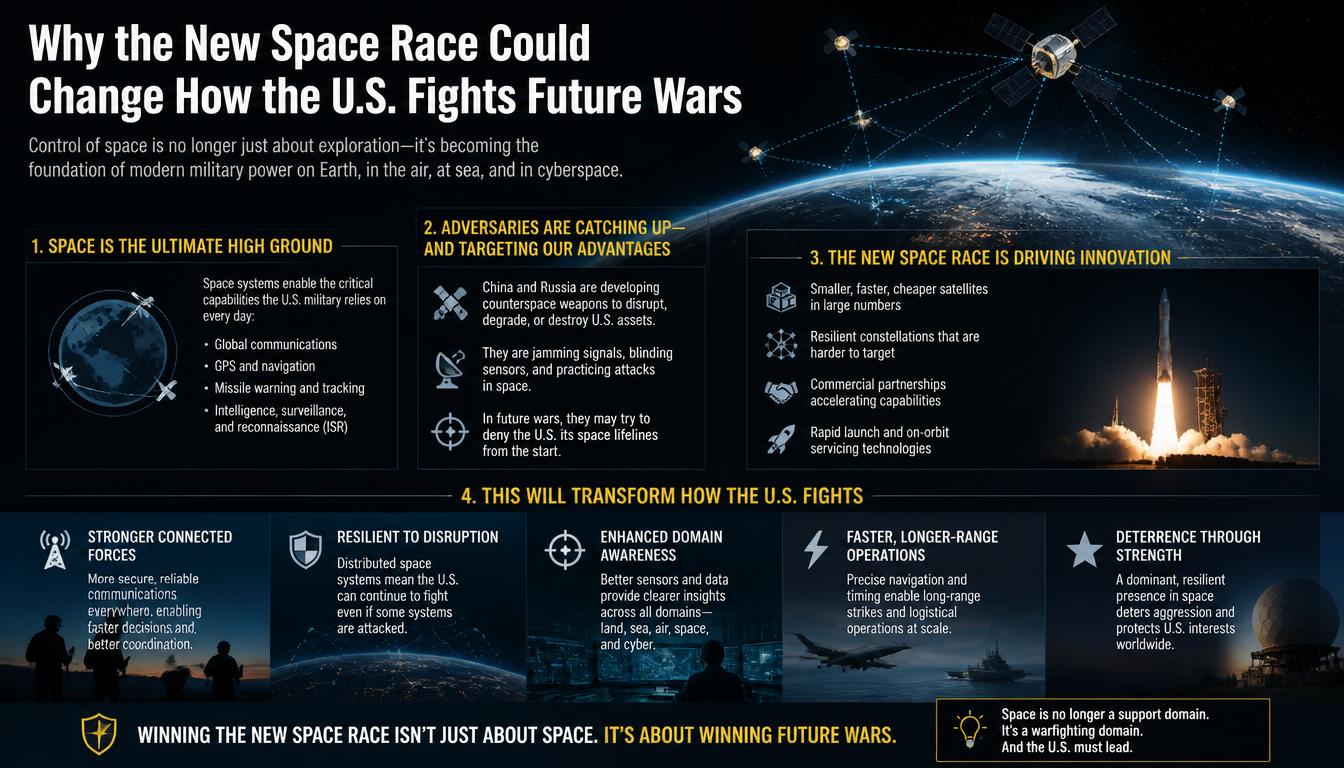
For decades, the idea of a space war sounded like science fiction.
Today, it is becoming a serious military planning issue.
The United States, China, Russia and their allies are developing increasingly sophisticated space capabilities, while military forces are becoming more dependent on satellites for communications, navigation, intelligence and missile warning.
That is creating a new strategic competition above Earth.
And for the United States, the issue is bigger than simply launching more satellites.
The central question is becoming:
Can America’s military continue fighting effectively if space itself becomes a contested battlefield?
That question is already influencing U.S. military planning and reshaping cooperation between Washington and its allies.
Space Is No Longer Just a Support System
Modern military operations depend on space in ways that are easy to overlook.
Satellites can provide communications, positioning, navigation and timing, intelligence, surveillance, missile warning and other data needed by military forces.
The U.S. Space Force describes satellite communications and positioning, navigation and timing as core mission areas, including resilient communications and more secure, jam-resistant GPS capabilities.
This creates an important vulnerability.
If an adversary can disrupt, jam, hack or physically attack critical space systems, the consequences could extend far beyond orbit.
A military unit could lose communications.
Navigation systems could become less reliable.
Commanders could have less information about what is happening on the battlefield.
Missile-warning systems could face disruption.
That is why the new space race is increasingly about resilience, not simply dominance.
The U.S. Is Building a More Resilient Space Architecture
Washington is already moving toward a space architecture designed to be harder to disable.
One example is the U.S. Space Force’s Resilient Missile Warning and Tracking program.
In September 2026, Space Systems Command announced a critical design milestone for the next phase of its Medium Earth Orbit missile-warning and tracking system. The program is intended to expand global missile tracking and provide additional layers of battlespace awareness for the United States and its allies.
The strategy is significant because it moves away from dependence on a small number of highly valuable systems.
More distributed satellite architectures can make it harder for an adversary to eliminate an entire capability with a limited number of attacks.
The Space Force has also described its broader approach to resilience as involving proliferated and redundant systems, cyber protection, commercial partnerships and resilient networks.
In simple terms:
Instead of building a few extremely important satellites, the U.S. increasingly wants networks that can keep working even when some components are attacked or disrupted.
NATO Is Turning Space Into an Alliance Issue
This transformation isn’t happening in the United States alone.
NATO formally recognized space as an operational domain in 2019, alongside land, sea, air and cyberspace.
The alliance says space capabilities are important for communications, navigation, intelligence gathering, crisis response and collective defense. NATO also warns that satellites are vulnerable to interference and that Russia and China have developed counter-space capabilities.
That creates a new question for America’s alliances:
What happens when a military conflict reaches space?
NATO has already established that attacks to, from or within space could create a challenge to the alliance’s security and could potentially lead to consideration of Article 5, depending on the circumstances and political decisions involved.
That doesn’t mean every satellite disruption automatically triggers a military response.
But it demonstrates how seriously NATO now treats space security.
NATO’s New HALO Initiative
In July 2026, NATO took another step.
Eight member countries launched an initiative called HALO — Hybrid Alliance Layered Operations in Space.
The participating countries are Canada, Denmark, Finland, Germany, the Netherlands, Norway, Sweden and Türkiye.
The initiative aims to connect sovereign military satellites operated by different NATO members into a networked architecture.
According to NATO, the system is intended to improve communications, intelligence and missile tracking while increasing resilience and overcoming some of the cost, coverage and time limitations of individual national satellite fleets.
This is important for Washington because America’s military alliances are increasingly becoming technological networks as well as traditional military partnerships.
A future NATO operation could depend on information gathered by satellites belonging to several countries, combined with U.S. systems and commercial space services.
The result is a more interconnected defense architecture.
The Commercial Space Industry Is Becoming Part of Defense
There is another major change that could reshape America’s military strategy:
private space companies.
The space industry is no longer dominated exclusively by governments.
Commercial companies operate large satellite constellations, provide imagery, communications and other services, and are developing technologies at a much faster commercial pace than many traditional government programs.
NATO’s Commercial Space Strategy, endorsed in 2025, specifically calls for closer cooperation with commercial space providers.
The strategy seeks to make commercial space services available during peace, crisis and conflict while improving the resilience and interoperability of allied space capabilities.
For the United States, this creates both an opportunity and a challenge.
Commercial companies can provide additional capacity and innovation.
But military dependence on private infrastructure also raises questions about cybersecurity, availability, ownership and what happens to commercial systems during a major conflict.
The boundary between the military and commercial space sectors is therefore becoming increasingly difficult to define.
China Is Building Its Own Space Capabilities
The other major part of this competition is China.
U.S. military assessments have repeatedly identified China’s space and counter-space capabilities as an important strategic concern.
The U.S. Department of Defense reported that China had more than 500 ISR-capable satellites by the end of 2024 and that these systems can support surveillance and targeting activities.
U.S. Space Command has also described Chinese development of counter-space capabilities designed to disrupt or potentially attack satellites.
These include systems involving jamming, lasers, direct-ascent anti-satellite weapons and maneuverable spacecraft.
More recently, Reuters reported that the United States and China are developing increasingly sophisticated technologies involving maneuverable satellites, spaceplanes and other systems that could potentially be used to interfere with or disable spacecraft.
The important point is that the competition is no longer simply about who can put the most satellites into orbit.
It is increasingly about:
Who can protect their satellites?
Who can detect threats first?
Who can continue operating if satellites are attacked?
And potentially:
Who can deny an adversary the same advantages?
Why GPS Matters to Americans
Space competition may sound like something happening far away from everyday life.
But Americans already depend heavily on space-based systems.
GPS is the obvious example.
People use it for navigation, transportation and location services.
Businesses and infrastructure also rely on precise timing and positioning.
The military depends on GPS and other space-based systems for operations.
The U.S. Space Force says its next-generation GPS III constellation is designed to improve accuracy and resistance to jamming. Space Systems Command reported in 2026 that the GPS III series had been completed, providing upgraded capabilities for military and civilian users.
That illustrates why space security isn’t only about astronauts or military satellites.
It is also about protecting the technological infrastructure that modern society has built around space.
The U.S. Is Also Preparing for Missile Threats From Space
Missile defense is another major reason space has become strategically important.
The United States is developing increasingly distributed satellite systems to detect and track missile launches.
In July 2026, the Space Development Agency announced approximately $1.75 billion in agreements for 36 additional space vehicles supporting missile warning, missile tracking and missile defense capabilities.
These systems are intended to provide broader and more resilient coverage.
The concept is straightforward:
Detect the threat earlier. Track it continuously. Give commanders more information.
That requires sensors in space.
And as missile technology becomes more sophisticated, including maneuvering and hypersonic systems, the ability to detect and track those threats becomes increasingly important.
The Most Important Change May Be Resilience
The phrase “space race” can make people imagine a competition to put the biggest satellite or the most powerful spacecraft into orbit.
But today’s competition is more complicated.
The United States is increasingly pursuing a layered space architecture involving:
- Military satellites
- Commercial satellites
- Allied satellite networks
- Missile-warning systems
- GPS and alternative navigation capabilities
- Space-domain awareness
- Cybersecurity
- Rapid launch capabilities
- Ground-based networks
The goal is not simply to have more assets.
It is to make the overall system harder to disrupt.
U.S. Space Command’s 2026 Space Warfighting Environment 2040 framework describes the need to prepare for an increasingly contested space environment as competitors develop their own capabilities.
That means future military power could depend heavily on something that most people cannot see.
The network connecting everything together.
What Happens If a Satellite Is Attacked?
This may become one of the most difficult security questions of the coming decades.
Suppose an adversary interferes with a military satellite.
What if the interference comes from a cyberattack?
What if communications are jammed?
What if a satellite is physically damaged?
What if a commercial satellite providing critical military services is targeted?
And what if several countries’ systems are affected at the same time?
The military response would depend on the circumstances, the nature of the attack, attribution and political decisions.
There is no simple automatic answer for every scenario.
But NATO’s space policy shows that an attack involving space systems can have implications for collective defense.
That makes space another potential point of interaction between military technology and alliance commitments.
The New Space Race Is Also an Alliance Race
The biggest change may therefore be happening on Earth rather than in orbit.
Countries are realizing that they cannot necessarily build every capability independently.
The United States has an enormous space industrial base.
Europe has its own satellite and launch capabilities.
Japan, Canada, Australia and other U.S. partners are developing or operating increasingly sophisticated space systems.
NATO is trying to connect these capabilities more effectively.
The HALO initiative is one example.
Commercial partnerships are another.
And U.S. Space Force programs increasingly emphasize cooperation with allies and commercial providers.
The result could be a future in which military space power is measured not only by what one country owns.
It could also be measured by how well its network of partners can operate together.
What This Means for America’s Future
The first space race was primarily about exploration and national prestige.
The new space race is different.
It is about communications.
Navigation.
Missile warning.
Intelligence.
Resilience.
And the ability to keep military forces connected when an adversary is actively trying to disrupt them.
For the United States, that means the future of military power may increasingly depend on what happens hundreds or thousands of miles above Earth.
But there is an important distinction.
A more militarized space environment does not necessarily mean a war in space is inevitable.
The United States, its allies and its competitors still have strong incentives to avoid the catastrophic consequences of a large-scale conflict that could create debris, damage satellites and disrupt systems used by both militaries and civilians.
The competition is therefore also about deterrence, resilience, rules and communication.
The Bottom Line
The new space race isn’t simply a contest to reach another planet.
It is becoming a contest over who can see, communicate, navigate and operate when space becomes contested.
For America, that means the future of military alliances may depend increasingly on satellite networks just as much as ships, aircraft and troops.
And if future conflicts are shaped by information moving through space, the most important battlefield may be one that most people never see.
The next great military advantage may not come from controlling more territory on Earth.
It may come from keeping the network above it alive.
Recommended Article: