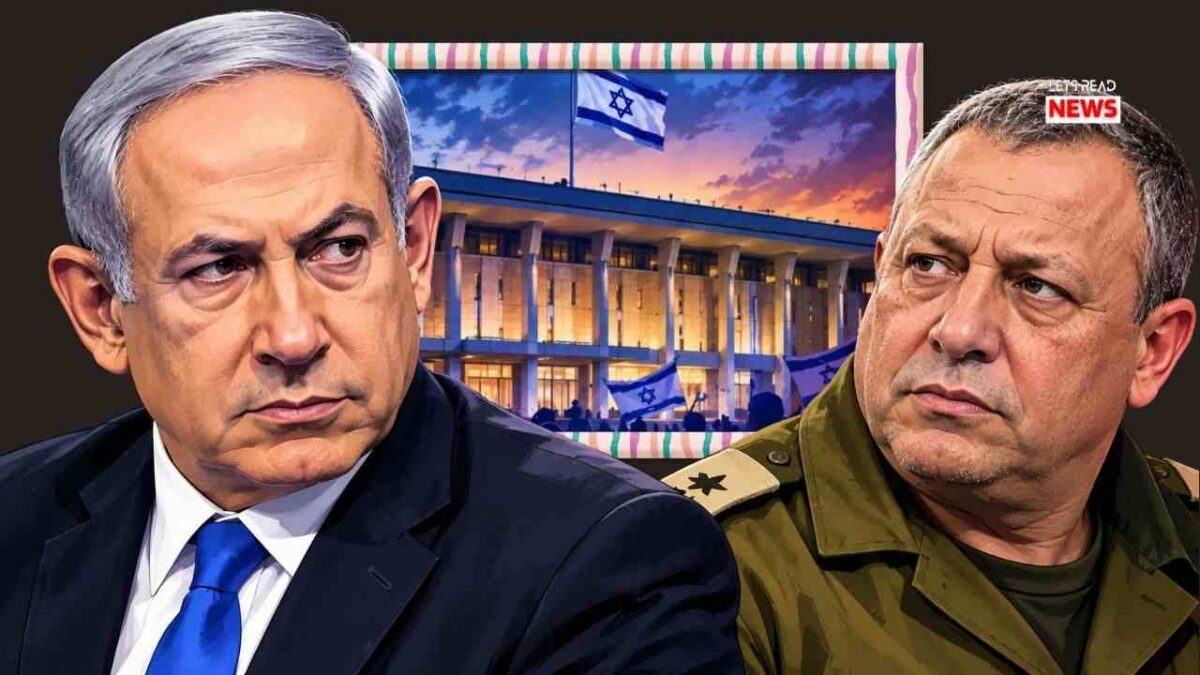
Israel’s Election Leaves Netanyahu Facing an Uncertain Political Future
Israeli Prime Minister Benjamin Netanyahu is facing a significant political setback after voters delivered a warning to his far-right governing coalition in the country’s October 2026 general election.
However, the election has not produced a clear winner.
Exit polls indicated that Netanyahu’s political bloc and the opposition led by former military chief Gadi Eisenkot were both short of the 61 seats needed to form a majority in Israel’s 120-seat parliament, known as the Knesset. Arab-led parties also appeared positioned to gain influence in the next parliament.
The result sets the stage for potentially weeks of negotiations as political leaders attempt to assemble a government.
Although Netanyahu’s opponents have an opportunity to challenge his leadership, their ability to form a coalition remains uncertain because of disagreements over cooperation with Arab-led parties.
The outcome could shape Israel’s domestic politics, its approach to regional security, and its relationships with the United States and other international partners.
Netanyahu’s Coalition Faces Voter Backlash
The election was widely viewed as a referendum on Netanyahu’s leadership following years of political division, security crises, and conflict.
The October 7, 2023, Hamas-led attack on Israel and the wars that followed transformed the country’s political landscape. The government’s handling of security, the war in Gaza, and the continuing regional challenges became central issues for voters.
Netanyahu’s supporters regard him as an experienced leader who has defended Israel’s security and confronted threats from its regional adversaries.
His critics argue that his government has failed to take sufficient responsibility for the security failures surrounding the October 7 attack. They also accuse him of prolonging the war in Gaza for political reasons, weakening democratic institutions, and relying too heavily on far-right allies.
Disputes over military conscription have added to public frustration. In particular, exemptions for significant sections of the ultra-Orthodox Jewish population have become a contentious issue as Israeli soldiers continue to shoulder the country’s military burden.
These disagreements helped turn the election into a broader debate about national security, political accountability, and the future direction of Israel.
The preliminary results suggest that Netanyahu’s coalition has lost political ground. Nevertheless, the prime minister has called for the formation of a strong, right-wing government and continues to argue that his political camp should lead the country.
Gadi Eisenkot Emerges as Netanyahu’s Main Challenger
Gadi Eisenkot, a former chief of staff of the Israeli military and leader of the Yashar party, has emerged as Netanyahu’s principal challenger.
Eisenkot campaigned on a message of national unity and political change, presenting himself as a leader with substantial security experience who could offer an alternative to Netanyahu’s government.
His military background is an important part of his political identity. Supporters see him as a leader capable of addressing Israel’s security challenges while reducing some of the domestic divisions associated with the current government.
Eisenkot has also called for greater national unity and changes to policies involving military service and the independence of the judiciary.
However, his political challenge extends beyond winning votes.
Israel uses a parliamentary system in which governments are generally formed through agreements between multiple political parties. A party can win the largest share of the vote without having enough seats to govern independently.
Eisenkot must therefore persuade potential coalition partners to work together, despite disagreements over security, religion, and relations with Arab political parties.
Even if Netanyahu’s coalition loses its majority, the opposition cannot assume that it will automatically take power.
The election has created an opportunity for Eisenkot, but the negotiations that follow will determine whether he can turn that opportunity into a government.
Why Arab-Led Parties Could Determine Israel’s Next Government
One of the most significant developments in the election has been the strong performance of Arab-led political parties.
Israel’s parliament has 120 seats, meaning that a government generally needs the backing of at least 61 lawmakers to secure a majority.
Exit polls suggested that neither Netanyahu’s bloc nor Eisenkot’s opposition grouping had reached that threshold on its own.
Arab-led parties, meanwhile, appeared positioned to win a substantial number of seats.
Their parliamentary strength could make them influential in negotiations over the next government.
However, their potential role presents a difficult political dilemma.
Netanyahu has rejected the idea of forming a government that depends on Arab-led parties, describing such an arrangement as a threat to Israel’s national interests.
Eisenkot has left open the possibility of cooperation under certain conditions, including recognition of Israel as a Jewish state and opposition to Hamas as an extremist group. Nevertheless, some potential partners have rejected working with Arab-led factions.
These competing positions complicate the opposition’s path to power.
Even if a majority of lawmakers oppose Netanyahu’s return as prime minister, they may struggle to agree on an alternative government.
The result could be prolonged negotiations, a minority government dependent on outside support, or another election if no viable coalition emerges.
For Arab citizens of Israel, the election also represents an opportunity to increase their political influence. Their representation could affect debates over equality, public services, discrimination, and the treatment of Palestinian citizens within Israel.
The extent of that influence will depend on whether other parties are willing to negotiate with them.
Israel’s War and Security Challenges Remain Central
The election took place against the backdrop of continuing security challenges and the consequences of years of conflict.
The October 7 attack, the war in Gaza, fighting involving Hezbollah in Lebanon, and tensions with Iran have shaped Israeli public opinion.
Netanyahu has emphasized Israel’s military achievements and argued that his government has confronted threats to the country’s existence.
His critics, however, question whether military operations have delivered the strategic and political outcomes Israel needs.
The conflict has also affected Israel’s international standing. Its conduct in Gaza and the occupied West Bank has drawn criticism from governments and international organizations, while disagreements over the war have strained relationships with some of its traditional partners.
Netanyahu faces an international arrest warrant relating to alleged crimes against humanity in Gaza, allegations he denies. The existence of the warrant is a separate legal matter from the election result.
Any new Israeli government would inherit these challenges.
Eisenkot’s military background suggests that a change in leadership would not necessarily mean a fundamental shift away from a security-focused approach. The next government would still face difficult decisions involving Iran, Gaza, Lebanon, the Palestinians, and the protection of Israeli civilians.
The central question is whether a new coalition would pursue different diplomatic and domestic policies while maintaining many of the country’s existing security priorities.
What the Election Means for the United States
The outcome matters to Washington because Israel remains an important American partner in the Middle East.
Relations between the two countries involve military cooperation, intelligence sharing, regional security, and diplomatic efforts concerning Iran and the Israeli-Palestinian conflict.
A new Israeli government could seek to improve the country’s international standing and reconsider aspects of its approach to the war and regional diplomacy.
However, it would be premature to assume that an Eisenkot-led government would fundamentally transform US-Israel relations.
Eisenkot is a former military commander with strong national-security credentials, and Israel’s underlying strategic concerns would remain.
The composition of the next coalition will be particularly important. Religious and nationalist parties could demand policy concessions in exchange for joining a government, while centrist parties could push for changes in domestic governance.
For American policymakers, the immediate concern is therefore not simply whether Netanyahu remains prime minister. It is also which political forces shape the next government’s decisions.
The election has created uncertainty, but the final policy direction will depend on the coalition negotiations and the priorities of the parties involved.
What Happens Next in Israel’s Political Crisis?
Israel’s election process now moves toward the formation of a government.
As the remaining ballots are counted, the preliminary picture may change. Exit polls provide estimates rather than official final results, and the allocation of parliamentary seats ultimately determines which political combinations are possible.
President Isaac Herzog will play a central constitutional role in the next stage. Following consultations with political parties, the president must select the candidate considered best positioned to form a government.
That candidate will then have to negotiate with other parties to assemble a viable coalition.
The process could take weeks, particularly if the main political blocs remain close and Arab-led parties become necessary to secure a majority.
If no candidate can form a government, Israel could face another election.
The country has experienced repeated electoral deadlocks in recent years, demonstrating how difficult it can be for its fragmented political system to produce a stable parliamentary majority.
Netanyahu has survived numerous political crises during his career. The current election presents another major challenge, but it does not yet establish that his political career is over.
For Eisenkot, the challenge is equally significant: he must turn the opposition’s electoral performance into an agreement capable of governing the country.
The Bottom Line: A Political Setback, but Not Yet a Final Defeat
Israel’s 2026 election has exposed the limits of Netanyahu’s political dominance while leaving the country’s next government uncertain.
The results suggest that many voters want a different direction, but the opposition remains divided over how to achieve that change.
Arab-led parties could become influential in the coalition negotiations, yet resistance to working with them may prevent Netanyahu’s opponents from assembling a parliamentary majority.
The coming negotiations will determine whether Israel experiences a change in leadership or enters another period of political deadlock.
For now, one conclusion is clear: winning votes and forming a government are two different challenges in Israel’s parliamentary system.
The question is no longer just whether Netanyahu’s coalition has weakened. It is whether his opponents can agree on who should govern Israel next.
Reporting note: This article reflects the preliminary election picture available on October 28, 2026. Exit polls and partial counts are not final results. The final parliamentary composition and outcome of coalition negotiations may differ from early projections.
Also Read :