

A strike on Gulf undersea cables wouldn’t just slow the internet. It would hit the world’s fastest-growing data economy, freeze financial transactions across three continents, and expose how much of the “cloud” actually sits at the bottom of the sea.
Here is a number that should terrify every finance minister, central banker, and hedge fund manager on earth: roughly 99 percent of global internet traffic travels through undersea cables. Satellites — the ones Elon Musk’s Starlink wants you to think run the world — carry a rounding error. When geopolitics meets plumbing, the plumbing wins.
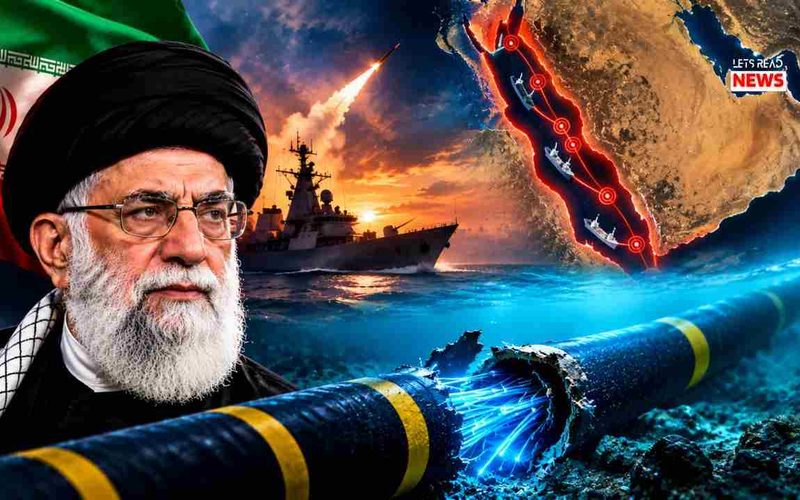
Iran’s reported plans to target Gulf cables, disclosed by two senior security officials to Reuters this week, are therefore not a regional nuisance. They are a threat to what has quietly become the world’s newest critical financial artery.
The Threat Is Real, Even If the Global Impact Isn’t
Start with the reassuring news. Alan Mauldin of TeleGeography estimates less than 1 percent of international bandwidth passes through the Strait of Hormuz, which means the global internet would not collapse if those cables were cut.
Traffic reroutes. The system is resilient by design.
But “the internet survives” and “the economy survives” are very different statements.
The cables beneath the Gulf do not exist to serve European Netflix users. They serve the Gulf itself — and the Gulf has spent the past five years building one of the most aggressive digital economies on the planet. The United Arab Emirates and Saudi Arabia have poured tens of billions of dollars into data centres, AI infrastructure, and cloud regions, positioning themselves as the digital bridge between Europe, Asia, and Africa. During the March conflict, Iranian strikes directly hit two Amazon Web Services facilities in the UAE — a preview of how precisely Tehran can aim at the digital layer.
Cut the cables connecting those facilities to the world, and the damage is not measured in tweets failing to load. It is measured in:
- Frozen financial transactions. Gulf sovereign wealth funds — among the largest capital pools on earth — execute trades and settlements through these connections. Hours of outage mean missed settlements; days of outage means forced deleveraging.
- Disrupted payments and e-commerce. Analysts warn that several simultaneous cuts could slow internet service and cripple payments, e-commerce, and cloud computing across the region.
- Energy markets. The Gulf is not just where oil is produced; it is where a growing share of the pricing and trading of that oil now happens — electronically, in real time, through data centres. An outage during a live conflict would inject violent uncertainty into already jittery crude markets.
The Insurance Problem Nobody Prices In
The most dangerous phrase in the Reuters report is not about the attack — it is about the repair. One Iranian official said Tehran would try to block repair efforts so outages would last longer.
This is where a cable attack stops being a military event and becomes a market event. Repairs during wartime face soaring insurance costs and delays in getting permits — meaning restoration measured in weeks, not days.
And there is precedent. After Houthi attacks forced shipping reroutes through the Red Sea, cable damage there in 2024 caused weeks of degraded connectivity across the Middle East and into Asia. Mauldin notes the Red Sea carries about 10 percent of inter-regional traffic — making it a far juicier target than Hormuz, even though Tehran has pointedly not said it plans to strike there.
Read that silence carefully: it may be deterrence theater — or it may be Iran keeping its best card off the table until it is needed.
The market has never seriously priced “telecom infrastructure as a war target.” The first time it does, expect: a spike in cyber and war-risk insurance premiums, a re-rating of Gulf data centre equities, capital flight from digital-economy projects that looked bulletproof last quarter, and — perversely — a rally in satellite communications providers.
Why Tehran Is Talking at All
The critical analytical question is whether Iran intends to do this — or intends to be believed.
Alex Vatanka of the Middle East Institute reads it as the latter: “Tehran wants Gulf states and corporate executives to press (US President Donald) Trump over the risks his policies pose to their investment plans.”
This is economic deterrence, and it is clever. The Gulf monarchies are not Iran’s enemy — but their prosperity is hostage to a war they do not control. The second Iranian official made the coercion explicit: Gulf states “should hold Washington, not Tehran, responsible for any damage to undersea cables.”
That is not a threat against the Gulf. That is an attempt to recruit the Gulf as Iran’s lobbying arm in Washington.
It may work. Nobody with a data centre in Dubai wants to be the collateral proof of concept for Iranian capability — especially with the US ambassador to Turkey telling reporters this weekend that a strike “absolutely” could come, and Trump only shrugging that he doesn’t know anything about it.
The Bottom Line
The global financial system assumed — without ever quite saying so — that the seabed was demilitarized. That assumption is now dead.
A Hormuz cable attack would be survivable; a Red Sea attack would not be trivial; and the threat of either is already doing its job — pushing Gulf capital, Gulf governments, and Gulf lobbyists toward pressuring Washington before a single fibre optic line is cut.
Markets price risks they can measure. Nobody has a model for “the cloud is at the bottom of a war zone.” The first cut would be a proof of concept for a whole new asset class of geopolitical risk — one priced not in basis points, but in weeks of darkness.
FACT BOX: Gulf Digital Infrastructure at Risk
| Item | Detail |
|---|
| Traffic share through Strait of Hormuz | <1% of international bandwidth (limited global effect if cut) |
| Traffic share through Red Sea | ~10% of inter-regional traffic — far more consequential |
| Global internet via undersea cables | ~99% of all traffic (ITU) |
| Regional impact scenario | Simultaneous cuts → slow internet, disrupted payments, e-commerce, cloud computing |
| Repair risk | Wartime repairs face high insurance costs + permit delays = weeks of outage |
| Key facilities already hit (March war) | 2 Amazon Web Services data centres in UAE struck directly |
| Publicly threatened targets | 7 major internet cables under Hormuz (Javani, Oct 21); US-linked data centres & AI facilities Gulf-wide (Rezaei) |
| Gulf states named as targets of coercion | UAE, Saudi Arabia, Qatar — top global investors in data centres & AI infrastructure |
| Unsaid but implied | Red Sea cables — 10× traffic of Hormuz — not publicly threatened; possibly held in reserve |
| Stated trigger | Any renewed US/Israeli attack on Iran: “no more red lines” |
Also Read:


1 comment