
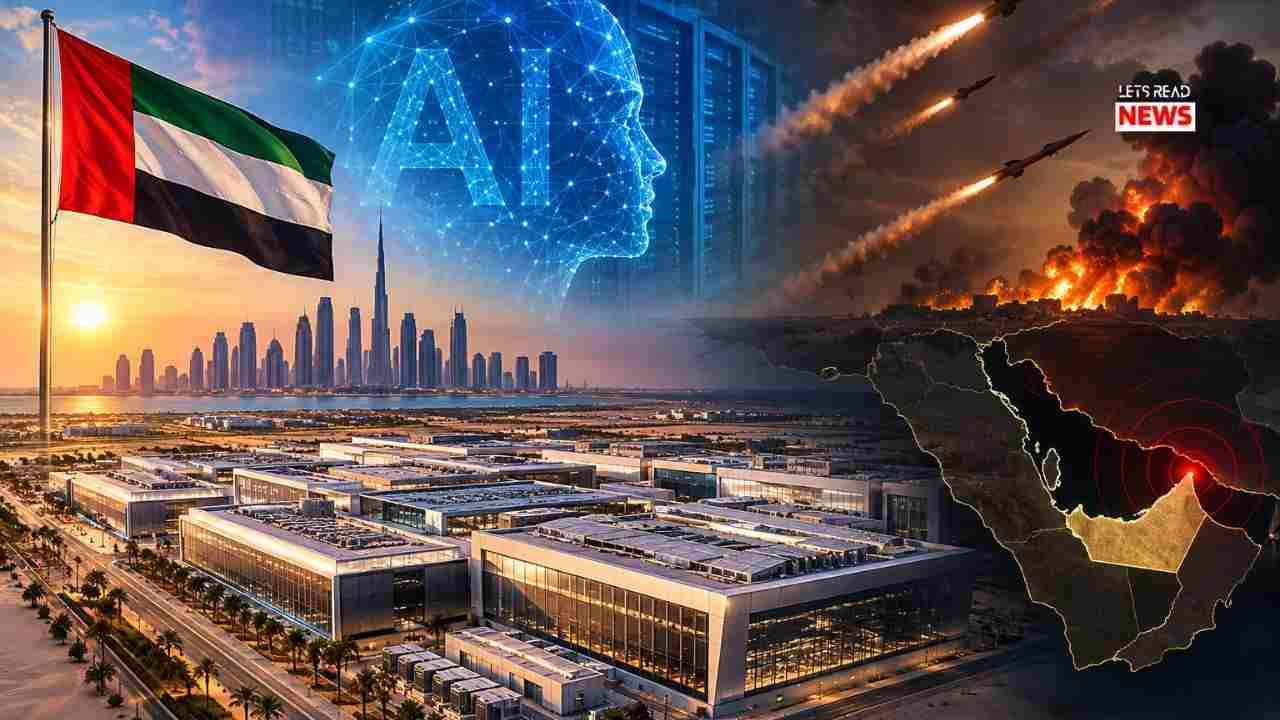
The Gulf’s ambition to become a global artificial intelligence hub has collided with an unexpected engineering problem: how do you protect enormous computing facilities when the region itself is exposed to military conflict?
The United Arab Emirates is revising plans for a vast artificial intelligence data-center campus after Iranian missile and drone attacks damaged cloud-computing infrastructure in the Gulf. The proposed changes include distributing facilities across the country, strengthening critical structures against blasts, and considering underground locations for particularly sensitive workloads.
The shift could have consequences far beyond the UAE. It raises a question facing governments and technology companies around the world: Can the next generation of AI infrastructure be built at the scale the industry wants without creating enormous, vulnerable targets?
A five-gigawatt ambition meets a security problem
The original UAE–U.S. AI campus was designed to become one of the world’s largest concentrations of computing capacity outside the United States. The planned site in Abu Dhabi covers about 10 square miles—roughly 26 square kilometres—and is intended to reach as much as five gigawatts of power capacity.
That figure describes the amount of electricity the larger campus could eventually consume. It is not the same as the amount of computing power available today.
The first stage, known as Stargate UAE, is a one-gigawatt AI cluster. Its initial 200-megawatt deployment was planned for 2026, with infrastructure involving G42, OpenAI, Oracle, NVIDIA, Cisco, and SoftBank.
The scale is important because advanced AI systems require enormous amounts of computing power. Training and operating these systems involves thousands of specialised processors, high-capacity networking, cooling equipment, and a reliable electricity supply.
A large campus can make those systems easier to build and operate. It can also concentrate risk.
If a single location contains a substantial share of a country’s strategic computing infrastructure, an attack, prolonged power failure, or major cooling-system disruption could affect many customers at once.
What changed after the strikes?
The security concerns became more concrete after Iranian attacks damaged Amazon Web Services facilities in the UAE and Bahrain in March 2026.
AWS subsequently faced prolonged disruption in parts of its Gulf infrastructure. Customers were advised to move workloads to alternative regions, illustrating how a physical attack on a data center can become a problem for banks, businesses, public services, and software companies that depend on cloud computing.
The UAE’s response is not to abandon AI infrastructure altogether. Instead, officials are rethinking how it should be distributed and protected.
According to Reuters, the revised approach includes a network of smaller installations rather than relying entirely on one enormous campus. Some critical systems could be placed inside blast-resistant structures, while underground locations are being considered for sensitive government and defense workloads.
The distinction matters: the reporting describes a redesign and security considerations, not a completed nationwide move of AI servers into bunkers.
Why underground computing is attractive—and difficult
Putting a server facility underground can offer some protection from certain external threats. A properly engineered subterranean structure may reduce exposure to blast effects, flying debris, and some forms of direct physical attack.
But burying a data center does not make it invulnerable.
AI computing equipment produces substantial heat. Underground facilities still need cooling systems, ventilation, electrical distribution, fire protection, maintenance access, and reliable connections to external networks.
They also need protection against threats that do not depend on a building’s location, including cyberattacks, power-grid failures, supply-chain disruptions, and damage to communications infrastructure.
There is another engineering complication in the UAE: geology and geography vary considerably across the country. Underground construction in a mountainous area is not the same as excavating beneath an urban or desert site. Rock conditions, groundwater, access routes, construction costs, and emergency evacuation requirements all affect whether a subterranean data center is practical.
For that reason, underground construction is better understood as one part of a broader resilience strategy—not a universal solution.
The case for spreading AI infrastructure across the Emirates
A dispersed network of facilities could reduce the consequences of an attack on any single location.
Imagine a computing system divided among several sites:
- One facility handles training workloads.
- Another serves customers in real time.
- A third supports government or defense applications.
- Additional sites maintain backup capacity and data-recovery systems.
If one location becomes unavailable, some workloads could potentially be transferred elsewhere.
This arrangement is known as geographic redundancy. It is already an important principle in cloud computing, where providers operate multiple availability zones and regions to reduce the risk of a single point of failure.
However, redundancy has limits. Several facilities in the same geographic area may still be exposed to the same conflict, electricity disruption, or communications failure. A resilient design therefore needs more than multiple buildings: it needs independent power, diverse network routes, backup systems, tested recovery procedures, and clear rules about which workloads can be moved.
For the UAE, the challenge is to balance security with the efficiency that made the original megacampus attractive.
Stargate UAE is bigger than a data-center project
The infrastructure is part of the UAE’s broader effort to build an economy around advanced technology, rather than relying primarily on hydrocarbons.
The country has invested heavily in artificial intelligence, computing infrastructure, and international technology partnerships. G42 is central to the Stargate UAE initiative, which involves major American technology companies and advanced NVIDIA computing systems.
The project also carries a strategic dimension. Access to advanced AI processors, secure computing infrastructure, and frontier AI models is increasingly linked to national competitiveness.
For Washington, partnerships of this kind involve questions about technology exports, data security, and how powerful AI systems are deployed.
For Abu Dhabi, the goal is to establish the UAE as a major center for AI development and deployment.
For technology companies, the Gulf offers capital, energy resources, and an ambitious market—but also a region where geopolitical risks cannot be ignored.
The economics of a more secure AI campus
A distributed system could be more resilient, but it may also be more expensive.
A single large campus can share cooling systems, power infrastructure, security operations, and network connections. Smaller facilities require some of those systems to be duplicated.
Underground construction introduces additional costs and engineering requirements. Hardened structures may need stronger materials, specialized access systems, and more complex maintenance arrangements.
The financial question is therefore not simply whether the UAE can build more data centers. It is whether the additional cost of protecting and distributing them is justified by the value of the computing capacity they will support.
For AI companies and governments, that calculation is becoming increasingly important. A facility that is inexpensive to build but difficult to protect may prove more costly over its lifetime than a network designed for resilience from the beginning.
What this means for the future of AI infrastructure
The UAE’s rethink points to a wider change in the way the AI industry may approach physical infrastructure.
For years, the central challenge was securing enough chips, electricity, land, and cooling capacity to meet growing demand. Now, in regions exposed to conflict, physical security is becoming part of the infrastructure equation.
Future AI facilities may increasingly combine several strategies:
Geographic distribution: Avoiding dependence on one large campus.
Hardened construction: Protecting critical equipment from selected physical threats.
Independent power systems: Reducing exposure to interruptions in the wider electricity grid.
Network diversity: Maintaining multiple communications routes.
Workload portability: Making it possible to move computing tasks between locations.
Data recovery: Ensuring that an outage does not permanently destroy critical information.
None of these measures eliminates risk. Together, however, they can reduce the chance that one incident will bring a large computing operation to a halt.
The bigger question
The UAE’s AI ambitions have not disappeared because of the attacks. The reported redesign suggests that the country is trying to adapt its infrastructure rather than abandon its place in the global AI race.
But the episode highlights a difficult reality.
Artificial intelligence may be digital, yet the systems that power it are physical. They depend on buildings, electricity, cooling, fiber-optic cables, engineers, and secure locations.
As AI becomes more important to governments, businesses, and national security, protecting that physical foundation may become just as important as developing faster chips or more capable models.
The UAE’s next move could therefore serve as a test case for the entire industry: how do you build the world’s largest AI systems in a world where the infrastructure itself can become a target?
Also Read:

1 comment