California’s AI Onslaught: 30 Bills on Newsom’s Desk as the Clock Ticks Down
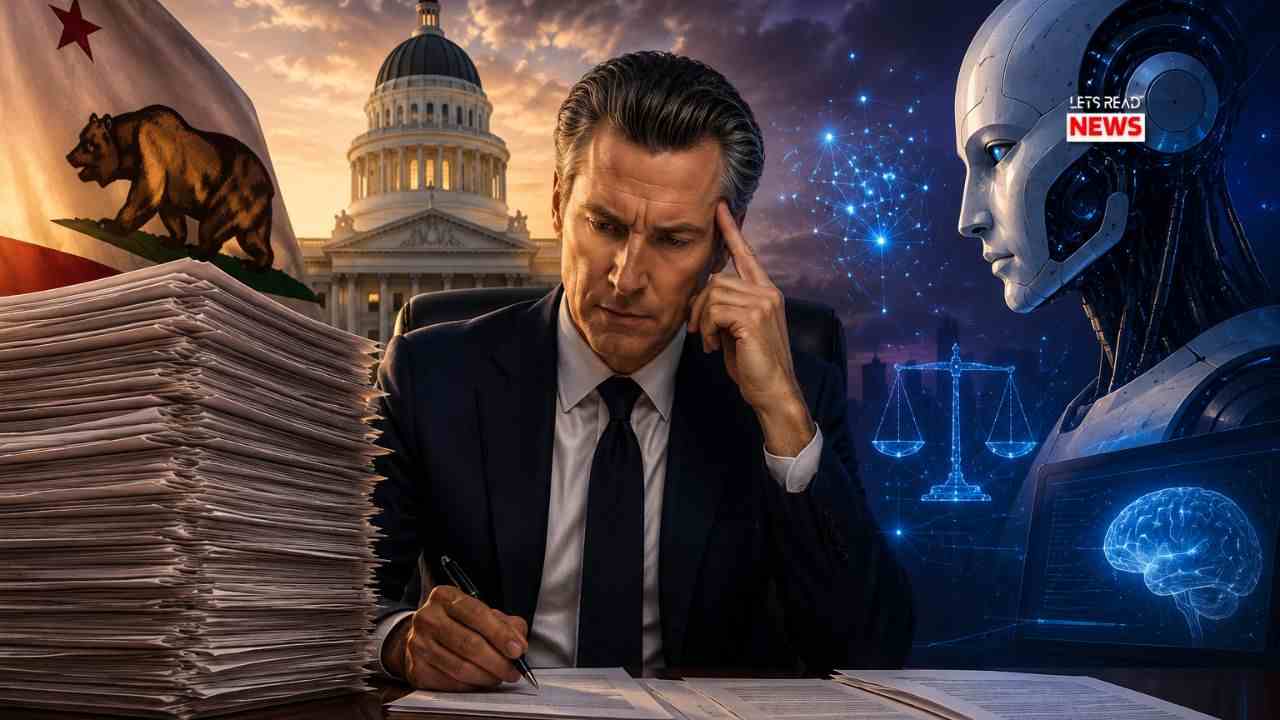
With four weeks left until the September 30 deadline, Governor Newsom faces the most consequential tech-regulation decision of his career — and Silicon Valley is lobbying hard.
September 4, 2026 — Four days after California lawmakers gavelled out of session, the Capitol is quiet. But in Sacramento’s corner offices and Silicon Valley boardrooms, the real battle has just begun. Governor Gavin Newsom is now reviewing the largest package of AI and social-media legislation ever passed by a single U.S. state — roughly 30 bills that, taken together, would rewrite the rules for how technology interacts with children, workers, patients, and voters.
He has until September 30 to sign or veto each one. No decisions have been announced yet. But the lobbying is already ferocious.
The Full Picture: What’s Actually on the Desk
Earlier reports cited 26 bills, but the final count is closer to 30, covering everything from toy chatbots to attorney ethics. The Transparency Coalition’s latest tracking reveals the breadth of what lawmakers sent to Newsom in the session’s final hours:
Child Safety & Social Media
- AB 2: Makes social-media platforms liable for damages if they fail to exercise “ordinary care” and cause injury to a child.
- AB 1709: Bans “addictive features” — autoplay, infinite scroll, personalized feeds, engagement-driven push notifications — for users under 16.
- AB 1159: Extends student privacy protections (KOPIPA/ELPIPA) to digital operators that market services for school use.
- AB 1792: Requires schools to teach digital violence, dating abuse, and deepfake awareness in health classes.
- AB 2071: Mandates digital-health literacy as part of existing health-education courses.
Chatbots & Companion AI
- SB 1119 (“Adam’s Law”): Named after the late Adam Raine, this significantly strengthens pre-release safety testing, mandatory age verification, independent audits, and crisis-support resources for chatbots that interact with teens. It also creates liability for harmful outputs — self-harm content, sexually explicit material, romantic role-play, and emotionally manipulative behavior.
- SB 867: Bans companion chatbots in toys for five years.
- SB 903: Bars licensed mental-health professionals from letting AI make independent therapeutic decisions or detect patient emotions/mental states.
- AB 1609: Regulates customer-service chatbots.
- AB 1979: Classifies healthcare chatbots as healthcare providers subject to medical confidentiality laws.
Workplace Surveillance & Labor
- AB 1883: Prohibits employers from using AI to collect “neural data” or infer workers’ emotional states. Violations carry up to $500 per violation, with a private right of action.
- SB 947: Limits employer reliance on automated decision systems (ADS) for discipline and termination.
- SB 951: Requires 90-day notice before “technological displacement” affecting 25% or more of the workforce.
Healthcare & Education
- SB 503: Requires developers of AI clinical-decision-support tools to identify and mitigate bias risks.
- AB 2575: Guarantees healthcare workers the right to override AI-powered clinical recommendations using professional judgment.
- SB 928: Mandates that California State University instructors be human — AI can assist, but not replace, the teacher.
Transparency, Liability & Governance
- AB 2713: Tightens the California AI Transparency Act by requiring platforms to disclose whether provenance data or digital signatures are embedded in content, not merely “available.”
- SB 1000: Strengthens AI disclosure and provenance-data rules.
- AB 1405: Creates a state AI Auditor Registry — unregistered entities cannot legally conduct AI audits in California.
- SB 813: Establishes standards for third-party independent verification organizations (IVOs) certifying AI compliance.
- SB 1159: Clarifies that AI systems are not “persons” or “members of the public” under open-meeting and public-records laws.
- SB 1111: Expands false-impersonation laws to include malicious use of digital replicas.
- SB 574: Sets ethical standards for attorneys using AI.
- AB 1651: Governs AI use in administering the State Bar exam.
The Stakes: Why This Week Matters
Newsom is not starting from a blank slate. His track record on AI legislation is already well-established, and it points to a governor who supports targeted regulation but vetoes broad mandates.
What he’s signed:
- SB 53 (September 2025): The Transparency in Frontier AI Act — requiring safety frameworks, whistleblower protections, and incident reporting for large AI developers.
- SB 243 (October 2025): Required chatbot disclosure and safety rules for users showing signs of mental distress.
What he’s vetoed:
- AB 1064 (October 2025): A companion-chatbot restriction for minors, which Newsom called so broad it would “unintentionally lead to a total ban on the use of these products by minors.”
- SB 7 (October 2025): The “No Robo Bosses Act,” which would have required notice of AI use in employment decisions. Newsom called its notification requirements “unfocused” and “overly broad.”
- SB 771 (October 2025): Platform liability for civil rights violations, which he deemed unnecessary given existing law.
The pattern is clear: Newsom signs surgical safety measures and vetoes sweeping prohibitions that he views as operationally impractical or preemptive.
The Betting Line: What Survives September 30
Based on Newsom’s established preferences, here is the likely trajectory:
High probability of signing:
- SB 1119 (Adam’s Law) and SB 867 (toy chatbot ban): These build directly on SB 243, which he already signed. The emotional appeal of child safety — especially with the bill named after a deceased teen — is politically potent.
- AB 2713 and SB 1000 (transparency tweaks): Narrow, technical updates to existing law. Low controversy, high alignment with his past actions.
- SB 1159 (AI not a “person”): A definitional clarification with minimal industry opposition.
Toss-ups:
- AB 2 (platform liability for children): Newsom vetoed SB 771 on similar grounds, but AB 2’s “ordinary care” standard is narrower. Child-safety advocates are pushing hard.
- AB 1709 (addictive-features ban): Massively disruptive to platform business models. Newsom may demand amendments or sign with reservations.
High probability of veto:
- AB 1883 (emotion/neural-data ban): Business opposition from the Chamber of Commerce and manufacturers is intense. Newsom has already shown discomfort with broad workplace-AI restrictions.
- SB 947 and SB 951 (employment AI notices/displacement): These echo SB 7, which he vetoed. The “unfocused” critique likely applies here too.
- AB 1405 (AI Auditor Registry): Creates a new state licensing bureaucracy. Newsom has historically been skeptical of novel regulatory regimes without demonstrated need.
The National Ripple Effect
California’s regulatory gravity is not theoretical. With nearly 39 million residents and a $3.9 trillion economy, the state is too large for tech companies to ignore. The “California effect” — where firms adopt the strictest standards nationwide to avoid multiple product versions — has already shaped auto emissions, data privacy (CCPA/CPRA), and chemical safety.
If even half of these ~30 bills become law, the impact cascades immediately:
- Social-media platforms must build age-verification infrastructure and strip addictive features for under-16 users — changes that will likely roll out nationally rather than maintain a “California version.”
- AI developers face pre-release safety testing, independent audits, and liability exposure for chatbot outputs, raising barriers to entry and extending development timelines.
- Employers must audit workforce analytics tools for emotion-recognition and neural-data capabilities, potentially removing features used in other states.
- Healthcare systems operate under stricter human-in-the-loop requirements for AI-assisted clinical decisions.
The counterargument — raised by TechNet, the Chamber of Commerce, and OpenAI — is that a patchwork of state regulations stifles innovation and drives AI development to lighter-touch jurisdictions.
But with Congress gridlocked and federal preemption stripped from recent legislation, Sacramento is filling the vacuum — whether the industry likes it or not.
The Bottom Line
As of September 4, 2026, Governor Newsom has 26 days left to decide the fate of roughly 30 bills. No signatures or vetoes have been announced. The tech industry is lobbying furiously. Child-safety advocates are running emotional campaigns. Labor unions are demanding workplace protections.
This is not merely a California story. What happens in Sacramento between now and September 30 will likely determine the default regulatory framework for AI and social media across the United States. Companies are already preparing compliance roadmaps for multiple scenarios. Investors are pricing regulatory risk into AI valuations.
Newsom’s desk is now the most important regulatory battlefield in global technology. The clock is ticking.
Governor Newsom has until September 30, 2026 to act on all pending legislation. Signing updates are published at https://www.gov.ca.gov.
Recommended for you: