Stuck on 33%: Why Trump’s Midterm Math Is Scaring Republicans
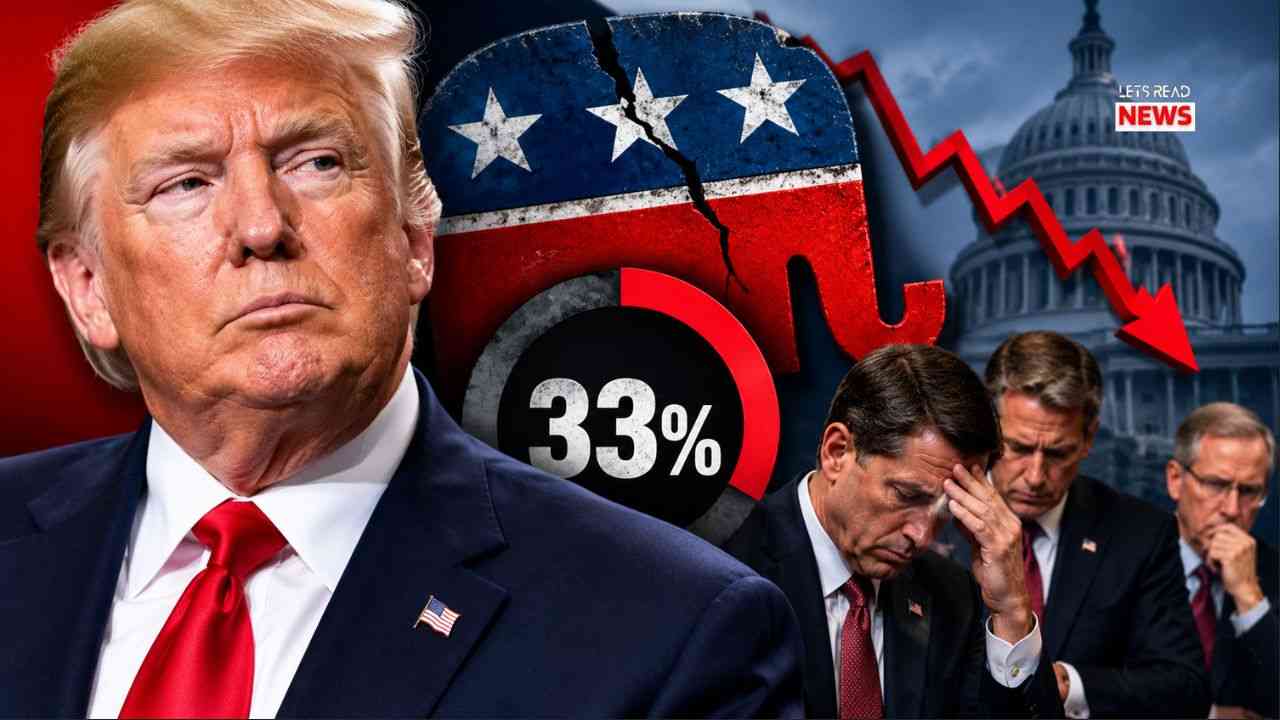
As the 2026 midterm campaign enters its final two-month sprint, President Donald Trump’s approval rating is stuck at a career-low 33%, and Republicans are beginning to accept that their fate may hinge on an “all-about-Trump” strategy they never wanted.reuters+2
The numbers that have GOP strategists nervous
Multiple recent polls paint a bleak picture for the party in power:
- Reuters/Ipsos (late August): Trump’s approval is at 33%, with 65% disapproving—including 49% who “strongly disapprove.” Only 13% of all voters strongly approve of his job performance.reuters+1
- UMass Amherst (Aug. 21–26): Overall approval down to 32%, with 64% disapproving. Among Republicans, approval has fallen 14 points since April, from 89% to 75%. One in six 2024 Trump voters say they would not vote for him again.
- Emerson College: Trump at about 39.5% approval among likely voters, with 86% of Republicans still approving—but that base intensity may not be enough in swing districts.
Republicans’ net disapproval is now nearly double what it was at this point in 2018, when Democrats gained 40 House seats.
Why the war in Iran and the economy matter
Two issues dominate voter dissatisfaction and are proving especially toxic for GOP candidates:
- War in Iran: Broad majorities disapprove of Trump’s handling of the conflict, which has driven up gas prices and airport delays. Moody’s estimates the war has cost U.S. consumers about $100 billion—roughly $750 per household.reuters+1
- Economic pain: Stubborn inflation, higher grocery and gas prices, and recent job losses (23,000 jobs lost in July, per one analysis) are giving Democrats a potent “kitchen-table” message.scanx+1
For Republicans who hoped to run on tax cuts and deregulation, the narrative has shifted to “Can you afford another two years of this?”
The strategic trap: “We’re stuck”
Inside the GOP, there’s a growing sense of being trapped:
- Many candidates privately admit they’re “stuck” with a Trump-focused midterm plan they believe could cost them seats, but they can’t afford to alienate the president or his $400 million super PAC.axios+1
- Some Republicans in competitive districts are quietly asking Trump not to campaign with them, even in areas he won by double digits in 2024, fearing his brand will drag them down.politicalwire+1
- Yet after a decade of tying themselves to Trump, most candidates have little room to maneuver; distancing themselves too far risks angering the MAGA base and losing crucial funding and endorsements.inquirer+1
The result is a party running a two-pronged message: attack the Democratic left while trying to sell Trump’s economic record—even as that record is increasingly defined by war costs and inflation.reuters+1
What this means for Congress
- House: Democrats are favored to retake the chamber, which would unleash new investigations into Trump’s administration and force compromise on legislation.
- Senate: Control remains closer, but models give Republicans only a 16–30% chance of a full sweep (keeping House, Senate, and White House).
For Republicans, the midterm math is simple and scary: with Trump’s approval at 33%, enthusiasm gaps widening, and economic and foreign-policy headwinds mounting, holding Congress looks like an uphill battle they may not win.
Recommended for you: