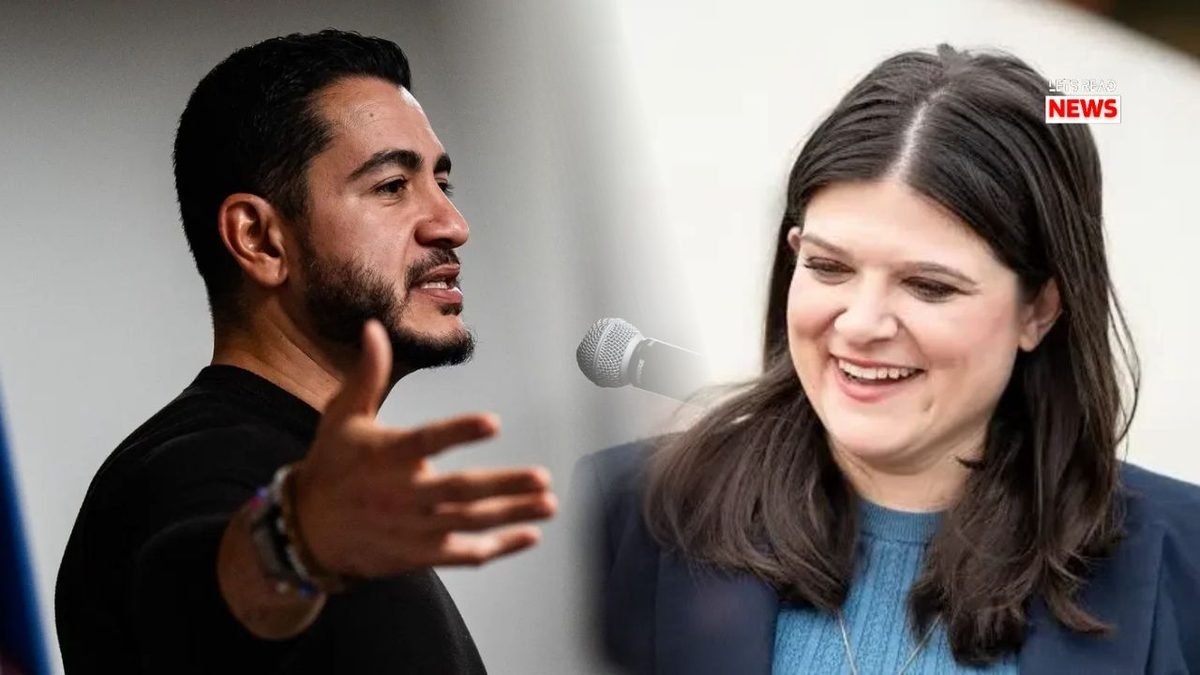
The Michigan congresswoman’s decision to endorse Republican Mike Rogers has exposed a deeper divide inside the Democratic Party. But an immediate $1.2 million fundraising surge raises a question Republicans may not want to ignore: Could a political rebellion against one candidate actually strengthen his campaign?
Michigan’s Senate race has taken an extraordinary turn just days before voters head to the polls. A Democratic congresswoman who lost her party’s Senate primary has publicly endorsed the Republican candidate, triggering an internal party revolt and an unexpected fundraising surge for the Democrat she once hoped to defeat.
On Sunday, November 1, Representative Haley Stevens endorsed Republican Mike Rogers over Democratic nominee Abdul El-Sayed. The announcement came after weeks of tension between Stevens and El-Sayed, who defeated her in the Democratic primary in August.
The political consequences were immediate.
El-Sayed’s campaign said it raised $1.2 million in just four hours following Stevens’ announcement. Meanwhile, several House Democrats began demanding that Stevens be removed from their caucus, arguing that endorsing a Republican in a competitive Senate race crosses a line that party membership should not tolerate.
President Donald Trump welcomed the development, praising Stevens for what he described as a brave decision.
But beneath the dramatic headlines is a more complicated political story. This is not simply a disagreement between two politicians. It is a confrontation over the future direction of the Democratic Party, the limits of party loyalty, the influence of outside political spending, and the difficult question of how Democrats should handle disagreements over Israel, progressive politics and the 2026 election.
And the timing could hardly be more consequential.
What Happened Between Haley Stevens and Abdul El-Sayed?
To understand the controversy, it is necessary to look beyond Sunday’s endorsement.
Stevens and El-Sayed were competing for the Democratic nomination to replace retiring Michigan Senator Gary Peters. The primary campaign was unusually bitter, with disagreements over policy, political identity and the direction of the Democratic Party.
Stevens represented a more moderate Democratic approach and was a strong supporter of Israel. El-Sayed, a physician and former Michigan gubernatorial candidate, ran as a progressive who has been sharply critical of Israeli government policy and American support for Israel.
Their differences became especially visible during the primary campaign, when outside political spending became a major factor.
An affiliated super PAC connected to the American Israel Public Affairs Committee (AIPAC) backed Stevens. El-Sayed objected to the influence of outside spending and argued that powerful political interests were attempting to shape the outcome of the Democratic primary.
The conflict did not disappear when the primary ended.
Although Stevens initially indicated that she would support the Democratic nominee, the relationship between the two camps remained strained.
One particularly controversial flashpoint involved an advertisement from an independent left-wing group that linked American support for Israel to rising grocery prices. Stevens demanded that El-Sayed condemn the advertisement, arguing that it unfairly placed responsibility for America’s economic problems on Jewish people.
El-Sayed said the advertisement was not produced by his campaign and stated that he disagreed with its contents.
However, the dispute continued.
Stevens also criticized El-Sayed’s political rhetoric and his association with controversial political commentator Hasan Piker. She argued that the campaign’s tone was damaging to the Democratic Party.
El-Sayed, meanwhile, accused Stevens of continuing to fight a primary election that had already ended.
The situation reached a breaking point during the final weekend before the election.
Why Did a Democratic Congresswoman Endorse a Republican?
Stevens’ decision was particularly striking because she had previously criticized Rogers in strong terms.
She had described him as a supporter of Trump’s agenda and warned against giving Republicans another Senate seat.
Yet on November 1, she appeared alongside Rogers at Perfecting Church in Detroit and announced her endorsement.
Her explanation centered on what she described as the growing hostility surrounding El-Sayed’s campaign.
Stevens said El-Sayed had indicated that she was no longer welcome in his campaign.
Her response was effectively that if she was not welcome, she would support his Republican opponent.
In a CNN interview with Anderson Cooper, Stevens defended her decision and said she felt a sense of relief. She accused El-Sayed of becoming increasingly angry and questioned whether his political approach represented the values she wanted the Democratic Party to promote.
She also insisted that she remained a proud Democrat.
This creates an important distinction: Stevens has endorsed a Republican candidate, but that does not automatically mean she has changed her party affiliation.
Her decision appears to reflect a breakdown in her relationship with the Democratic nominee rather than a publicly announced conversion to Republican politics.
Nevertheless, the political consequences of endorsing the opposing party’s candidate in a competitive Senate race are significant.
The $1.2 Million Question: Did Stevens Accidentally Help El-Sayed?
Perhaps the most interesting development is not Stevens’ endorsement itself, but what happened immediately afterward.
According to El-Sayed’s campaign, it raised $1.2 million during the four hours following Stevens’ announcement.
The campaign described it as its second-best fundraising day since winning the Democratic nomination in August.
That figure deserves attention for several reasons.
First, fundraising is not simply about collecting money. In the final days of an election, a sudden increase in donations can signal that supporters are paying attention, reacting emotionally and becoming more motivated to participate.
Second, the timing provides El-Sayed with a powerful political message.
Instead of allowing the endorsement to become a story about Democratic disunity, his campaign can present it as a moment when supporters rallied behind him.
Third, the fundraising surge gives the campaign an additional resource at a critical moment when there is very little time left before voting ends.
However, there is an important distinction between fundraising momentum and electoral momentum.
A $1.2 million fundraising announcement does not prove that El-Sayed has gained new votes. Donors are not necessarily representative of the wider electorate, and a contribution can come from someone who already supported him.
The campaign’s claim also does not establish how much of the money came from first-time donors, how many individual contributors participated, or whether the donations were concentrated among a relatively small number of large contributors.
Those details would help establish whether the reaction represents a broader expansion of his political support or an intense response from an existing base.
Still, the episode creates a potential political problem for Rogers.
His campaign gained a high-profile endorsement from a Democratic congresswoman, but the announcement also gave his opponent a major fundraising opportunity and an additional reason to attract media attention.
The endorsement may therefore deliver political benefits to Rogers while simultaneously strengthening El-Sayed’s ability to mobilize supporters.
Whether that trade-off helps Republicans will become clearer when voters cast their ballots.
The Democratic Party’s Internal Revolt: Can Stevens Actually Be Expelled?
The controversy has moved beyond campaign endorsements and into the rules governing the House Democratic Caucus.
Several Democratic lawmakers have publicly supported removing Stevens from the caucus.
Representatives Lateefah Simon of California, Marc Veasey of Texas and Emily Randall of Washington were among those expressing support for disciplinary action, according to Axios.
Representative Pramila Jayapal also criticized Stevens’ decision, arguing that supporting Rogers meant backing a candidate aligned with Trump’s administration.
The anger is understandable from the perspective of party leaders.
Political parties depend on cooperation, particularly when control of the Senate is at stake. A lawmaker publicly campaigning for the opposing party’s candidate can undermine the party’s electoral strategy.
But the question is whether Stevens has violated a specific caucus rule.
According to the House Democratic Caucus rules, members in good standing are prohibited from participating in campaign activities for candidates in partisan federal elections who are not members of the Democratic Party.
The rules also establish a two-thirds voting threshold for expulsion.
That means removing Stevens would not be an automatic consequence of her endorsement. It would require a formal political decision and sufficient support among caucus members.
There is another complication.
Stevens is leaving Congress at the end of her current term. Some Democrats have questioned whether launching a major disciplinary fight against a departing member is worth the political and institutional effort.
Others have suggested that the caucus may still need her vote during the remaining legislative session.
This creates an unusual situation: Democrats are debating whether to remove a member who is already on her way out of Congress.
The dispute could therefore become more symbolic than practical.
An expulsion would send a strong message about party loyalty. But it could also raise difficult questions about how much disagreement a political party should tolerate before treating dissent as disloyalty.
Why the Israel Dispute Is Bigger Than One Senate Campaign
One of the least understood parts of this controversy is the role of Israel in the Democratic primary.
The disagreement between Stevens and El-Sayed is not simply about campaign personalities.
It reflects a wider divide inside the Democratic Party over American policy toward Israel, the influence of pro-Israel political organizations and the relationship between foreign policy and domestic economic concerns.
Stevens has defended a strongly pro-Israel position. El-Sayed has taken a more critical approach toward the Israeli government’s policies and American support for them.
These positions reflect different political constituencies within the Democratic coalition.
For some Democratic voters, continued American support for Israel is an important foreign policy commitment. For others, particularly voters demanding a change in Washington’s approach to the conflict, the issue has become a major test of political representation.
The controversy over the independent advertisement made the disagreement even more sensitive.
Stevens argued that the advertisement crossed a line by suggesting Jewish people were responsible for economic problems in America. Such an accusation is not a legitimate substitute for examining actual economic policies or the decisions of political leaders.
El-Sayed said the advertisement was not his campaign’s work and that he disagreed with its contents.
That distinction matters.
A candidate should be judged on his own statements and policies, not automatically held responsible for every advertisement produced by an independent group supporting his political position.
At the same time, candidates can be expected to address controversial messaging when it appears to benefit their campaigns.
The broader challenge for Democrats is how to accommodate sharply different views on Israel without allowing foreign policy disagreements to destroy the coalition needed to win elections.
Michigan is now providing a particularly visible example of that challenge.
Why Michigan’s Senate Seat Matters to Washington
This is not an ordinary Senate contest.
Michigan is one of the most politically important battleground states in the country. Its voters include large urban populations, suburban communities, industrial workers, rural voters, younger progressives and important Arab American and Muslim communities.
Winning a statewide election requires building a coalition across groups that do not necessarily agree on every issue.
For Democrats, the challenge is to maintain support among traditional voters while also mobilizing younger and more progressive constituencies.
For Republicans, the opportunity is to attract moderate voters who are uncomfortable with the Democratic nominee while maintaining the support of Trump’s political base.
The seat is also important because Senator Gary Peters is retiring, leaving an open Senate seat.
An open seat can be especially difficult for a party to defend because there is no incumbent running to benefit from established statewide recognition and personal electoral support.
The result could influence the balance of power in Washington.
If Republicans retain or gain enough seats, they will have a stronger position in advancing Trump’s legislative priorities and confirming presidential nominees.
If Democrats gain control, they would have greater influence over Senate committees, legislation, investigations and the administration’s policy agenda.
That makes Michigan’s election relevant far beyond the state’s borders.
The Polling Numbers Tell a More Complicated Story
The endorsement arrived when El-Sayed was already performing well in several public polls.
A Mitchell Research & Communications survey conducted October 26–27 for CBS Detroit and other Michigan television stations showed El-Sayed leading Rogers by seven percentage points among likely voters.
The poll placed El-Sayed at 51% and Rogers at 44%, with a margin of error of plus or minus 3.9 percentage points.
More importantly, the survey suggested that El-Sayed had a stronger hold on Democratic voters and was performing well among independents.
According to the poll, 94% of Democratic voters supported El-Sayed, compared with 91% of Republicans supporting Rogers. Independents favored El-Sayed by 52% to 38%.
A separate polling average updated November 1 also showed El-Sayed ahead.
The New York Times/Siena University poll listed El-Sayed at 53% and Rogers at 42%.
These numbers provide important context for understanding Stevens’ endorsement.
Rogers is not entering the final days with an established polling advantage. Instead, his campaign is attempting to overcome a deficit in a race that Democrats see as essential to their national strategy.
However, polls are not election results.
Late-breaking developments, turnout, undecided voters and differences between polling methods can all influence the final outcome.
The endorsement could help Rogers attract moderate Democrats who share Stevens’ concerns about El-Sayed. But it could also motivate progressive voters who view the move as an attempt to undermine their primary choice.
The key question is not simply how many people agree with Stevens.
It is how many voters are willing to change their vote because of her endorsement.
The Turnout Battle Could Matter More Than the Endorsement
Michigan’s political geography makes this contest particularly interesting.
Detroit and Wayne County are central to Democratic statewide victories. Oakland County and suburban communities also play an important role in determining the final result.
The Associated Press reported that Stevens had performed strongly in Wayne and Oakland counties during the Democratic primary, drawing support from Black and Jewish voters.
That gives her endorsement potential significance beyond its national media attention.
She may have credibility among some voters who supported her in the primary and remain uncomfortable with El-Sayed.
But there is no guarantee that those voters will follow her recommendation.
Some may agree with her concerns but still vote for the Democratic nominee because they prefer the party’s national platform or oppose Trump’s administration.
Others may simply stay home, while some could consider Rogers.
The distinction between endorsement influence and actual voter behavior is crucial.
There is also the question of early voting.
Michigan’s early in-person voting began before the final controversy, and absentee voting was already underway. This means a portion of the electorate may have cast ballots before Stevens made her announcement.
Her endorsement therefore cannot influence every voter in the same way.
For campaigns, the remaining challenge is to reach those who have not yet voted and persuade them to participate.
In a close election, a relatively small shift in turnout could matter more than a nationally publicized endorsement.
Trump’s Reaction Adds Another Political Dimension
President Donald Trump quickly praised Stevens for supporting Rogers.
Speaking at a rally in Iowa, Trump described her decision as brave and suggested that she might eventually join the Republican Party.
His comments offer a glimpse into how Republicans want to use the endorsement.
For the GOP, the most valuable part of Stevens’ decision may not be the number of Democratic voters she can persuade.
It is the opportunity to portray the Democratic Party as divided, hostile toward moderates and unable to maintain unity even in a crucial Senate election.
Rogers can use the endorsement to argue that concerns about El-Sayed extend beyond Republicans.
It also provides Republicans with an opportunity to challenge Democratic claims that their party has broad support across Michigan.
But there is a risk for Republicans.
If the endorsement becomes a bigger story about El-Sayed’s fundraising success and the Democratic backlash against Stevens, the political narrative could shift away from Rogers’ campaign and toward a controversy that benefits his opponent.
Trump’s praise may help Rogers generate attention, but attention alone does not translate into votes.
Three Possible Outcomes From This Political Crisis
The consequences of the Stevens endorsement could develop in three different ways.
1. Rogers benefits from moderate Democratic voters.
If Stevens has significant influence among voters who supported her in the primary, her endorsement could persuade some of them to cross party lines.
This would be particularly important if those voters are concentrated in communities where El-Sayed needs strong Democratic support.
2. El-Sayed turns the controversy into a turnout advantage.
The $1.2 million fundraising surge suggests that the endorsement has energized at least some of his supporters.
If that enthusiasm translates into additional votes, Stevens’ decision could ultimately help El-Sayed rather than Rogers.
3. The controversy has little effect on the final result.
It is possible that most voters have already made their decisions.
In that case, the endorsement could dominate political headlines without changing the outcome.
This is an important possibility because political media attention and voter behavior are not always the same thing.
What This Means for the Democratic Party After November 3
Regardless of who wins Michigan, the controversy could leave a lasting mark on Democratic politics.
The party faces a difficult strategic choice.
Should it prioritize ideological unity and discipline, particularly when control of Congress is at stake? Or should it make room for moderate members who disagree with the party’s nominees on major political and foreign policy questions?
There is no easy answer.
A party that tolerates every form of internal opposition risks weakening its electoral strategy. But a party that punishes every serious disagreement risks alienating voters who do not share the views of its most progressive members.
The Stevens controversy also raises a question about the influence of primary elections.
If a candidate wins a legitimate party primary, should defeated rivals be expected to support that nominee regardless of their disagreements? And what happens when the nominee’s positions are fundamentally different from those of the defeated candidate?
These questions are not limited to Michigan.
They reflect a broader challenge facing both major American political parties: how to maintain coalitions that contain voters with very different ideas about the country’s future.
The Bottom Line: A Republican Endorsement Could Become a Democratic Fundraising Weapon
Haley Stevens may believe that endorsing Mike Rogers is the right response to what she considers unacceptable political behavior by Abdul El-Sayed.
Republicans, meanwhile, have gained an opportunity to highlight Democratic divisions at a crucial moment in the midterm campaign.
But the $1.2 million fundraising response complicates the story.
Instead of simply weakening El-Sayed, Stevens’ endorsement may have given his campaign a powerful final opportunity to mobilize supporters, attract donations and present itself as the candidate facing opposition from both political insiders and Republican allies.
The real test will not be how many lawmakers criticize Stevens, how loudly Trump praises her or how much money El-Sayed raises.
It will be the votes counted in Michigan.
On November 3, voters will decide whether Stevens’ endorsement changed the political equation—or whether it became one of the most expensive political miscalculations of the campaign.
And the consequences could reach all the way to Washington, where control of the United States Senate is at stake.
Also Read: