
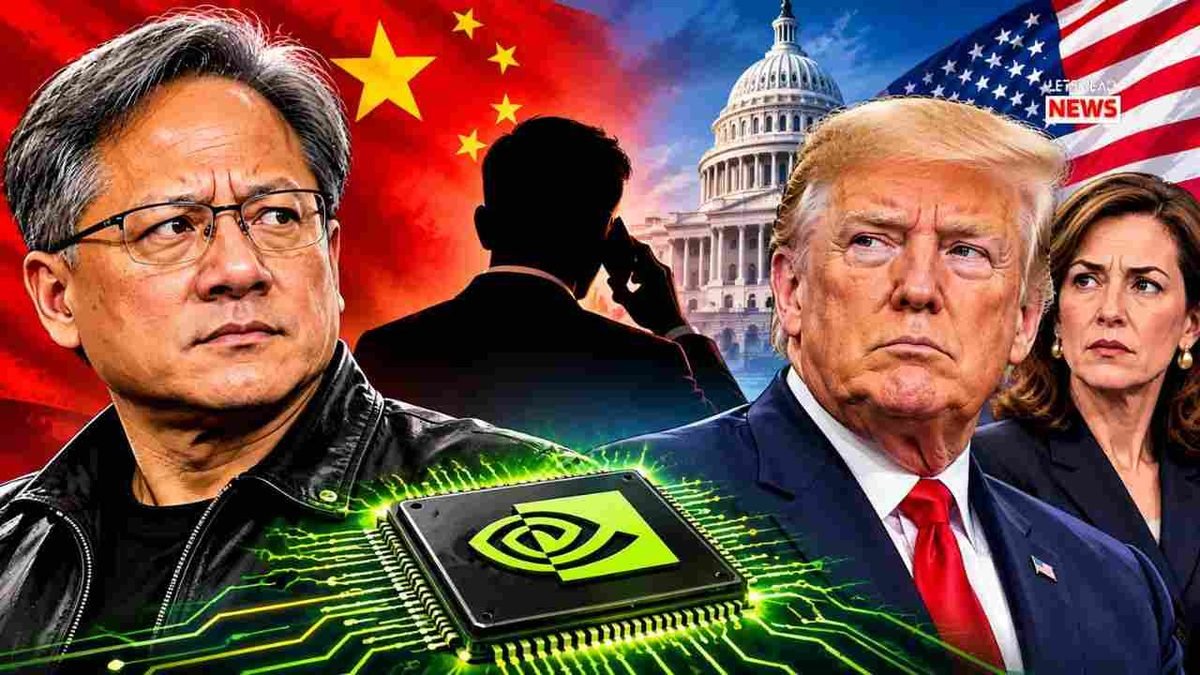
A reported Chinese intelligence operation involving a Singapore-based Nvidia customer has raised fresh national-security concerns. But a separate Justice Department inquiry into Nvidia’s Hugging Face deal points to a much bigger question: Is America’s most powerful AI chipmaker becoming too influential for Washington to leave unchecked?
Nvidia has spent the past few years becoming one of the most important companies in the global technology industry. Its chips power AI data centers, support the development of advanced language models, and sit at the center of America’s competition with China.
But the company is now facing a combination of problems that go beyond ordinary market competition.
A New York Times investigation has reported that U.S. intelligence agencies concluded that Alice Huang, also known as Huang Le, a former senior executive at Singapore-based data center company Megaspeed International, was acting as a Chinese intelligence asset. Investigators reportedly suspected that she was helping China gain access to restricted AI computing technology while developing a close relationship with Nvidia CEO Jensen Huang.
Nvidia has rejected suggestions that its CEO’s business relationship with the executive was suspicious. Jensen Huang has described the company’s dealings with Megaspeed as normal, saying Nvidia examined the firm’s GPU deployments and counted its chips.
At almost the same time, the U.S. Department of Justice has been asking questions about Nvidia’s proposed $12.93 billion acquisition of AI platform Hugging Face, raising concerns about competition and the company’s growing influence over the AI ecosystem.
These are separate matters. There is no established evidence that the reported espionage allegations and the antitrust inquiry are connected.
Nevertheless, together they highlight a difficult situation for Washington: the company America depends on to maintain its AI advantage is also a company whose global business relationships and expanding market power are becoming subjects of government scrutiny.
1. The real national-security concern is not just chip smuggling
The allegations surrounding Alice Huang are significant because they point to a vulnerability in America’s strategy for controlling advanced AI technology.
Washington has spent years restricting China’s access to some of the world’s most powerful AI processors. The objective is straightforward: prevent Chinese companies and military-linked organizations from obtaining computing power that could strengthen China’s AI capabilities.
However, controlling the physical movement of chips is not necessarily the same as controlling access to computing power.
Consider a different scenario.
A company in Southeast Asia legally acquires advanced AI servers and operates them inside a data center. Instead of shipping those servers directly to China, it provides computing services to customers through remote access.
The physical hardware remains outside China, but customers elsewhere may still be able to use its computing capacity.
This distinction is important.
A U.S. Congressional Research Service report published in April 2026 highlighted concerns that foreign developers could access advanced computing resources through cloud services, even when export restrictions limit their ability to obtain the physical chips themselves.
In other words, the AI export-control challenge is becoming more complicated. Washington must consider not only where chips are shipped, but also who ultimately controls, rents, operates and benefits from the computing power they provide.
The Megaspeed allegations bring this concern into sharper focus.
The New York Times reported that a Malaysian affiliate connected to Megaspeed purchased at least $4.8 billion in advanced AI equipment containing Nvidia technology between June 2024 and February 2026, based on trade records.
That figure deserves attention, particularly because the company involved was reportedly relatively small.
However, large purchases alone do not establish illegal activity. Nor does the reported intelligence assessment establish that Nvidia knowingly participated in any diversion of chips.
The more important unanswered question is whether U.S. export-control authorities can reliably follow the computing power after the hardware has crossed an international border.
2. Why Singapore and Malaysia matter in America’s AI-China competition
The geography of this story is important.
Singapore and Malaysia occupy strategic positions in Southeast Asia’s technology and data-center industries. Their location, international business connections and growing digital infrastructure make the region attractive for companies seeking to build computing capacity.
For American chipmakers, these markets offer opportunities to sell hardware and expand AI infrastructure beyond the United States.
For Washington, however, they also create a difficult enforcement environment.
The United States cannot simply assume that every data center outside China serves only customers in its host country.
A server installed in Malaysia could potentially provide computing services to customers in several countries. This makes the distinction between hardware ownership and end-user access increasingly important.
There are already signs that regional authorities are paying closer attention.
On October 15, Malaysian customs officials seized 30 servers containing advanced AI chips at Kuala Lumpur’s main airport. The shipment was suspected of violating export-control requirements and was allegedly being moved through the country using misleading declarations.
The equipment was valued at approximately 50 million Malaysian ringgit, or $12.2 million.
The seizure does not establish a connection to Megaspeed. But it demonstrates that the wider problem of controlling sensitive AI hardware through international supply chains is not merely theoretical.
For the United States, the challenge is becoming three-dimensional:
- Hardware: Where are advanced AI chips physically located?
- Access: Which customers can remotely use those chips?
- Ownership and control: Who operates the data centers and decides how computing capacity is allocated?
Unless all three questions are addressed, restrictions on physical chip exports may leave important gaps in America’s AI security strategy.
3. Jensen Huang’s position creates a difficult balancing act for Washington
Jensen Huang is not an ordinary technology executive in today’s geopolitical environment.
He leads a company that has become central to America’s AI infrastructure ambitions. His public comments and discussions with policymakers can influence debates about export restrictions, international trade and the future of the semiconductor industry.
At the same time, Nvidia has commercial reasons to maintain relationships with international customers.
Huang has repeatedly argued that American technology companies should remain competitive in global markets rather than surrendering opportunities to foreign competitors.
The reported Megaspeed investigation creates a sensitive dilemma.
If Washington tightens restrictions too aggressively, it could make it harder for Nvidia to sell its products in international markets and strengthen alternative suppliers.
But if authorities fail to enforce existing restrictions, Chinese organizations could potentially gain access to computing resources that Washington intended to keep beyond their reach.
According to The New York Times, President Donald Trump was briefed about the intelligence findings approximately a year ago but chose not to take action, partly because of concerns about disrupting Nvidia’s business.
That account is based on the newspaper’s reporting and has not been independently established through a public government finding.
The political question is nevertheless significant: How should the government balance the commercial success of a strategically important American company against national-security concerns involving its international business network?
Nvidia says its interactions with Alice Huang were ordinary business dealings. The company also says allegations that Megaspeed diverted chips were investigated and debunked.
China’s Foreign Ministry has rejected the espionage report as groundless speculation.
At this stage, the allegations should not be treated as proof that Nvidia or its CEO knowingly assisted Chinese intelligence.
4. The DOJ’s Hugging Face inquiry reveals another side of Nvidia’s growing power
The national-security controversy is only one part of Nvidia’s expanding relationship with Washington.
The Justice Department’s separate questions about Nvidia’s proposed acquisition of Hugging Face raise a different concern: competition.
Hugging Face is a major platform for developers working with artificial intelligence. It provides access to AI models, datasets and tools, making it an important part of the open-source AI ecosystem.
Nvidia’s proposed $12.93 billion acquisition would give the chipmaker a much larger position in the software and developer infrastructure surrounding AI.
According to Reuters, Justice Department officials have asked whether the acquisition could allow Nvidia to capture a fundamental distribution point for AI.
Why does that matter?
Imagine a company that already sells the machinery needed to manufacture a product also gaining greater influence over the software, tools and distribution network used to build that product.
It could create an exceptionally powerful commercial position.
Nvidia’s importance already extends beyond selling processors. Its CUDA software ecosystem, networking technology, developer tools and computing platforms help customers build and operate AI systems.
Owning a major AI development platform could extend that influence further.
The concern is not simply whether Nvidia would raise prices.
It is whether competing chipmakers and AI developers could continue to access an independent, open ecosystem without facing disadvantages.
Nvidia has said Hugging Face would continue supporting multiple chip, cloud and AI providers. The acquisition is expected to close in the first half of 2027.
Importantly, a Justice Department inquiry does not establish that the proposed deal violates competition law. It means regulators are examining its potential consequences.
5. The bigger issue: Can one company become too important to America’s AI strategy?
There is an unusual contradiction at the center of Nvidia’s position.
Washington wants Nvidia to succeed because its technology is essential to America’s AI ambitions.
But the more successful Nvidia becomes, the more difficult it may be for policymakers to manage the risks associated with its influence.
There are two separate dimensions to this problem.
First, national security.
If American AI processors are diverted to restricted customers or used through overseas computing arrangements, the effectiveness of U.S. export controls could weaken.
Second, market competition.
If Nvidia expands its influence from chips into software platforms, developer communities and AI distribution, competitors may become increasingly dependent on infrastructure controlled by the same company.
These challenges require different regulatory responses. Export-control enforcement cannot substitute for antitrust oversight, and antitrust investigations cannot solve the problem of foreign access to restricted computing resources.
Yet both point to the same underlying question: How much control over the future of AI should one private company possess?
For America, this is not simply a debate about Nvidia’s market share. It is about maintaining a competitive technology industry while protecting the infrastructure that supports national security.
6. Why Nvidia investors should look beyond the latest stock decline
Nvidia’s shares faced pressure on Friday, October 30, as the espionage report added another source of uncertainty.
But the decline cannot be explained by the China controversy alone.
The broader technology market was already under pressure following disappointing results and spending concerns involving Intel and Amazon.
By Friday’s close, Nvidia had fallen approximately 4.2%, while AMD lost 10.9% and Intel plunged 28.6%. The Nasdaq Composite declined 2.86%, and the semiconductor index fell 7.2%, according to Reuters.
This broader decline matters because investors were questioning whether enormous investments in AI infrastructure would generate sufficient returns.
The market is beginning to examine not only how quickly AI companies can expand, but also how much money they must spend to do so.
For Nvidia, the situation creates several risks that investors will need to monitor:
- Regulatory risk: Could the DOJ’s investigations affect Nvidia’s acquisition strategy, sales practices or commercial relationships?
- Export-control risk: Could tighter enforcement make international sales more difficult?
- Customer risk: Could data-center operators face additional compliance requirements before purchasing or deploying Nvidia hardware?
- AI spending risk: Will major cloud companies continue investing heavily in Nvidia-powered infrastructure if returns take longer than expected?
Nvidia is scheduled to report its fiscal third-quarter results on November 17, 2026. Investors will be watching the company’s financial performance, but management’s comments about demand, international markets and regulatory developments may be equally important.
A single news report does not establish a long-term problem with Nvidia’s business. But several overlapping questions about regulation, national security and AI spending are making the company’s future more complicated.
7. What happens next? Five questions Washington must answer
The immediate controversy may eventually fade from the daily stock-market headlines. The underlying policy questions will not disappear so easily.
1. Can investigators establish what information Alice Huang allegedly passed to China?
The reported intelligence assessment raises serious concerns, but the public record does not provide a complete account of the alleged information-sharing or its consequences.
2. Were advanced Nvidia GPUs actually diverted to restricted Chinese customers?
The distinction between suspected diversion, verified violations and lawful overseas cloud operations must be established through evidence.
3. Will the United States strengthen controls over remote access to AI computing?
Restricting physical chip exports may not be sufficient if sensitive computing capacity can be accessed from abroad.
4. Will Nvidia’s Hugging Face acquisition face additional regulatory conditions?
The DOJ’s concerns could lead to further scrutiny, negotiations or other regulatory action. The outcome remains uncertain.
5. Can America maintain its AI advantage without creating excessive dependence on one company?
This may be the biggest strategic question of all. America’s AI leadership depends on Nvidia’s technology, but long-term leadership also requires competition, innovation and a resilient supply chain.
The Bottom Line: Nvidia’s biggest challenge may be controlling the ecosystem it helped create
Nvidia’s latest controversy is about much more than a stock-market decline or an alleged intelligence operation.
It exposes a growing weakness in the global AI system: advanced computing power can move across borders through complex commercial arrangements, while the software platforms and infrastructure supporting AI are becoming increasingly concentrated.
For Washington, the answer cannot be limited to restricting which countries can purchase advanced processors. It must also consider who can access the computing power, how international data centers are monitored, and whether competition remains healthy as Nvidia expands beyond hardware.
For Nvidia, the challenge is equally complicated. The company must protect its commercial relationships and global growth while demonstrating that its technology is not undermining the national-security policies of the country where it is based.
The question facing America is no longer just who makes the world’s most powerful AI chips.
It is who controls the computing power, platforms and infrastructure that will shape the next generation of artificial intelligence.
Also Read: