How the EU-India Free Trade Deal Impacts the United States?
Lets Read News Short Summary
The landmark EU-India Free Trade Agreement, finalized January 27, 2026, creates a 2-billion-person market (~25% of global GDP) with major tariff cuts—96.6% of EU exports to India face reduced or zero duties on goods like cars (from 110% to 10%), machinery, chemicals, and pharmaceuticals. This risks trade diversion, eroding US exporters’ share in India’s booming market against more competitive European rivals. Geopolitically, it hedges against US tariff volatility (e.g., Trump’s policies), diversifies India’s trade away from America, and reduces US leverage in negotiations. It signals multipolar trade blocs, pressuring the US toward renewed bilateral engagement with India to counter exclusion.
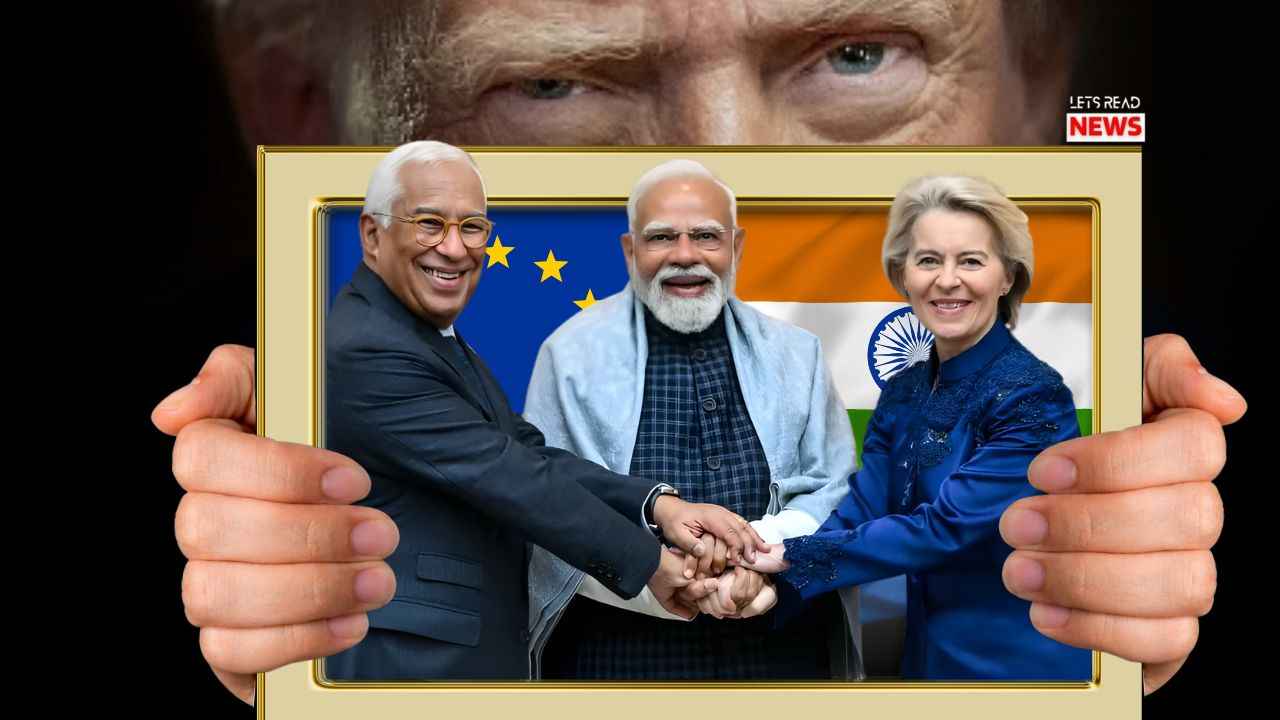
On January 26, 2026, the European Union and India concluded negotiations on a landmark Free Trade Agreement (FTA), hailed as the “mother of all deals” and the largest ever for both parties. This historic pact creates a free trade zone covering nearly 2 billion people and a combined market worth about $27 trillion—roughly 25% of global GDP.
The agreement eliminates or reduces tariffs on the vast majority of traded goods, with the EU committing to tariff cuts on 96.6% of its exports to India (by value), and India reciprocating on 86-93% of tariff lines. It is projected to double EU goods exports to India by 2032, saving European firms around €4 billion annually in duties, while boosting bilateral trade in sectors like automobiles, pharmaceuticals, machinery, textiles, and agri-food products.
For the United States, the deal arrives amid escalating trade tensions and carries significant economic and geopolitical ramifications.
Economic Impacts on US Trade
The FTA risks trade diversion in India’s fast-growing market. With sharply reduced tariffs, EU products will become more competitive than American equivalents in key sectors. For instance:
- India’s tariffs on EU cars will drop from up to 110% to as low as 10% over time (with immediate reductions to 30-35% in some cases), benefiting European manufacturers like Volkswagen, BMW, and Mercedes-Benz.
- Tariffs on wines, spirits, machinery, chemicals, and pharmaceuticals will also fall significantly for EU exporters.
US companies exporting similar goods to India could lose market share as EU alternatives gain a price advantage. This is especially relevant in industrial goods and consumer products where the US competes directly.
India’s motivations are partly defensive: US tariffs on some Indian goods have reached 50% (including a 25% penalty tied to India’s continued imports of Russian oil), contributing to a 21% drop in India’s exports to the US between May and December 2025. The EU deal allows India to diversify export destinations and reduce reliance on the US market, potentially limiting future US leverage in bilateral negotiations.
Geopolitical and Strategic Implications
The agreement is widely viewed as a strategic hedge against US trade policy volatility. Negotiations accelerated amid US tariff actions and threats, positioning the EU-India partnership as a counterweight to unpredictable American policies. Critics in the US administration, including Treasury Secretary Scott Bessent, have accused the EU of indirectly supporting Russia’s war efforts through the deal.
For Washington, this development signals a broader shift in global alliances. India is deepening economic ties with Europe while continuing to engage the US strategically (e.g., in defense and Indo-Pacific security). However, the FTA could erode US influence by encouraging multipolar trade blocs that exclude or marginalize America. As one of the largest trade deals of 2026 not involving the US, it underscores a trend toward diversified partnerships in response to protectionism.
Potential US Responses and Outlook
The deal may pressure the US to pursue more constructive engagement with India, including interim tariff reductions or a bilateral agreement to regain preferential access. Reports suggest ongoing talks between Washington and New Delhi for such measures.
In the longer term, the EU-India FTA highlights the costs of unilateral tariff strategies and the benefits of rules-based trade cooperation. While it poses near-term challenges for US exporters and strategic positioning, it also serves as a reminder that global trade remains dynamic—and that exclusion can accelerate alternative alignments.
The full implementation awaits legal ratification (expected within months to a year), but its ripple effects on US economic and foreign policy interests are already evident.
Sector-specific US impacts
The EU-India Free Trade Agreement (FTA), finalized in late January 2026, creates significant sector-specific challenges for US exporters and companies competing in India’s rapidly growing market. By granting the EU preferential tariff reductions—often immediate or phased over 5–10 years—on 96.6% of its exports to India (by value), the deal enhances European competitiveness relative to American goods in overlapping sectors.
This leads to trade diversion, where Indian importers shift toward cheaper EU alternatives due to lower duties, potentially eroding US market share. Below is a breakdown of the most affected sectors, based on the agreement’s tariff cuts and direct competition dynamics.
Automobiles and Automotive Parts
The EU gains substantial advantages here, with Indian tariffs on EU cars gradually reduced from up to 110% to as low as 10% (under a quota system of around 250,000 vehicles annually). Tariffs on car parts are set to be fully eliminated over 5–10 years.
- US Impact — American manufacturers (e.g., Ford, GM, Tesla) face heightened competition from European brands like Volkswagen, BMW, Mercedes-Benz, and Renault, which already have established presence or assembly in India. US exports could see reduced volumes as EU vehicles become more price-competitive, especially in the premium and mid-range segments. This exacerbates existing challenges from high Indian tariffs on non-preferential imports.
Machinery and Electrical Equipment
India agrees to eliminate or sharply reduce tariffs (up to 44% in some cases) on most EU machinery, with half liberalized immediately and the rest phased over up to 10 years. This includes industrial machinery, electrical equipment, and related goods.
- US Impact — US firms in heavy machinery, industrial equipment, and electronics (e.g., Caterpillar, General Electric, Honeywell) compete directly with European giants like Siemens, Bosch, and Schneider Electric. The preferential access could divert Indian procurement toward EU suppliers, leading to lost contracts and market share in India’s infrastructure and manufacturing boom.
Chemicals and Plastics
Tariffs of up to 22% on many EU chemicals and plastics are mostly eliminated or reduced significantly.
- US Impact — American chemical exporters (e.g., Dow, DuPont, ExxonMobil) risk displacement in sectors like industrial chemicals, polymers, and specialty materials. EU firms gain a clear price edge, potentially reducing US penetration in India’s expanding chemical processing and manufacturing industries.
Pharmaceuticals and Medical Devices
Indian tariffs of up to 11% on EU pharmaceuticals are largely eliminated, alongside benefits for medical devices and avionics.
- US Impact — While India is a major generic drug producer, US companies (e.g., Pfizer, Johnson & Johnson, Medtronic) export branded pharmaceuticals, innovative drugs, and advanced medical equipment. The deal strengthens EU competitors (e.g., Novartis, Roche, Bayer), which could capture more market share in India’s growing healthcare sector, particularly for high-value patented products.
Agri-Food and Beverages
The EU secures preferential access for wines, spirits, beers, olive oil, confectionery, and certain processed foods, with tariffs reduced or eliminated (e.g., olive oil duties fully removed from up to 45%).
- US Impact — US agri-food exporters (e.g., wines from California, spirits, processed foods) face indirect pressure, though the sector is smaller. More critically, if EU products gain dominance in premium segments, it could limit US opportunities in India’s urban middle-class consumer market.
Broader Implications and Less-Affected Areas
In sectors where the US has less direct overlap—such as textiles, leather, gems/jewelry, or marine products (where India gains EU access)—the impact is minimal or neutral. However, the overall effect reinforces India’s diversification away from US dependence amid ongoing tariff tensions.
US companies may respond by accelerating local production in India (via “China+1” strategies), pursuing bilateral concessions, or lobbying for US-India trade progress. The FTA’s phased implementation (full effects over years) provides some adjustment time, but early movers among EU firms could lock in advantages.
Overall, the deal underscores the risks of US protectionism: it accelerates alternative trade alignments, potentially costing American exporters billions in foregone opportunities in one of the world’s fastest-growing markets.