Understanding the 1944 U.S.-Mexico Water Treaty, Key Facts and Allocations
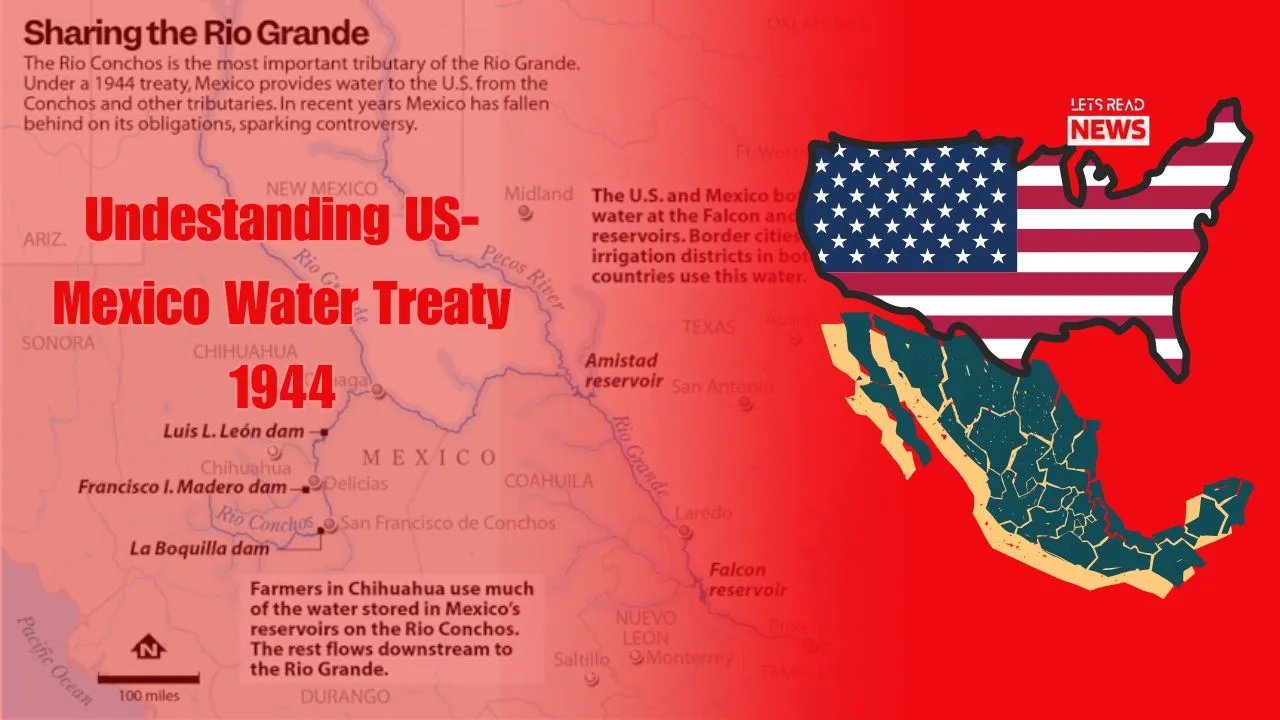
The allocations of the 1944 U.S.-Mexico Water Treaty (formally: Treaty relating to the utilization of waters of the Colorado and Tijuana Rivers and of the Rio Grande). lets understand this treaty with the help of tables for better understanding. I will use a column format to represent a multi-section infographic.
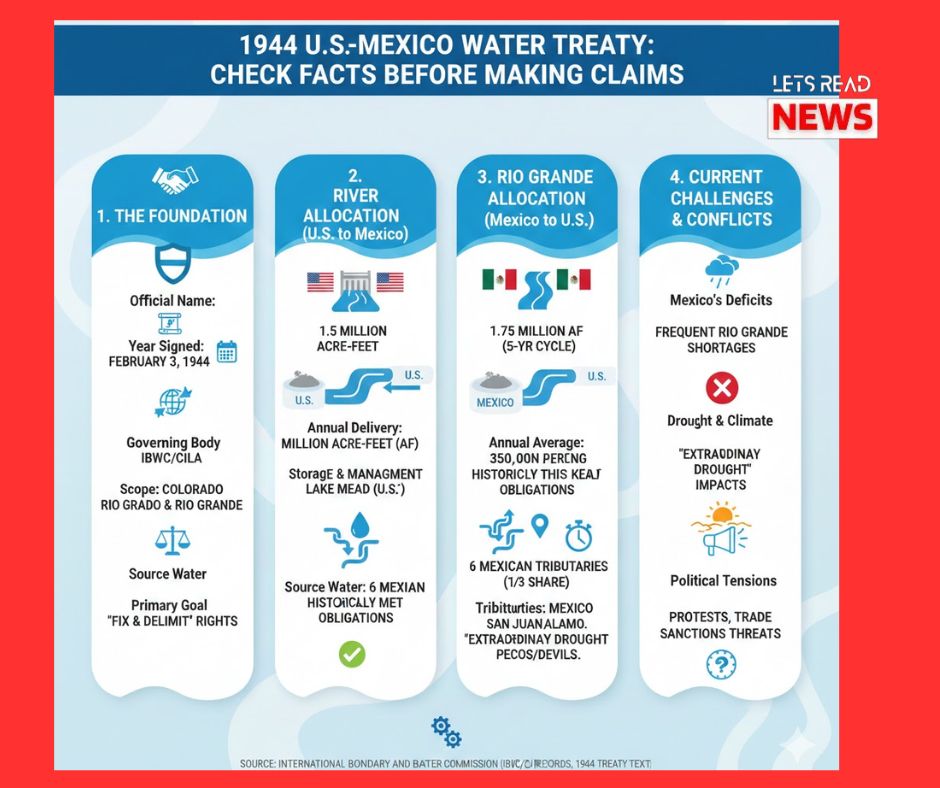
1944 U.S.-Mexico Water Treaty: Key Facts Infographic
1. The Foundation
| Point | Details |
| Official Name | Treaty relating to the Utilization of Waters of the Colorado and Tijuana Rivers and of the Rio Grande. |
| Year Signed | February 3, 1944. |
| Governing Body | International Boundary and Water Commission (IBWC/CILA). The treaty expanded the role of this binational body to resolve disputes and interpret the treaty via Minutes. |
| Scope | Allocates water from the Colorado River and the Rio Grande (Rio Bravo) below Fort Quitman, TX, to the Gulf of Mexico. |
| Primary Goal | To “fix and delimit” the rights of both countries to the waters to obtain “the most complete and satisfactory utilization.” |
2. Colorado River Allocation (U.S. to Mexico)
| U.S. Obligation | Amount | Details |
| Annual Delivery | 1.5 Million Acre-Feet (AF) | The United States must deliver this fixed amount of water to Mexico annually. |
| Storage & Management | U.S. and Mexico have agreed to cooperative measures (Minutes, like Minute 323) for managing shortages and storing some of Mexico’s water in Lake Mead (U.S.) during drought. | |
| Compliance | The U.S. has historically met its annual delivery obligations from the Colorado River. |
3. Rio Grande Allocation (Mexico to U.S.)
| Mexico Obligation | Amount & Cycle | Details |
| Delivery Requirement | 1.75 Million Acre-Feet (AF) | This is a cumulative minimum delivery requirement over a five-year cycle. |
| Annual Average | Must average 350,000 AF per year over the five-year cycle. | |
| Source Water | Water comes from six named Mexican tributaries, primarily the Río Conchos, with the U.S. being entitled to one-third of the flow from these tributaries. | |
| Tributaries | Mexico retains all water from the San Juan and Alamo Rivers. The U.S. retains all water from its own tributaries, like the Pecos and Devils Rivers. |
4. Current Challenges & Conflicts
| Challenge | Impact | Recent Context |
| Mexico’s Deficits | Mexico has frequently fallen behind on its five-year Rio Grande obligation since the 1990s, especially during periods of drought. | This creates water shortages for Texas farmers and municipalities in the Lower Rio Grande Valley. |
| Drought & Climate | Extraordinary Drought conditions (a term not clearly defined in the original treaty) reduce the water available in Mexican reservoirs and tributaries. | Mexico argues it cannot deliver water it doesn’t have, while the U.S. and Texas users cite the treaty’s priority. |
| Political Tensions | Non-compliance has led to political pressure, protests in Mexico, and occasional calls for U.S. federal action, including threats of trade sanctions. | Negotiation via IBWC Minutes is ongoing to improve the reliability and predictability of deliveries for the current and future cycles. |
Lets elaborate these sections in detail below :
The Enduring Framework: Understanding the 1944 U.S.-Mexico Water Treaty
The 1944 Treaty on the Utilization of Waters of the Colorado and Tijuana Rivers and of the Rio Grande is a cornerstone of U.S.-Mexico relations, serving as the foundational legal instrument governing water sharing along the vast binational border. Signed on February 3, 1944, the treaty aims to “fix and delimit” the rights of both nations to the waters of these three major river systems to ensure “the most complete and satisfactory utilization.”
Its administration falls under the International Boundary and Water Commission (IBWC/CILA), a binational body responsible for overseeing the treaty’s execution and resolving disputes. Critically, the IBWC operates through “Minutes,” which are binding, negotiated agreements that interpret and implement the treaty’s provisions, allowing for necessary operational flexibility and adaptation.
1. The Foundation and Governance
The treaty’s longevity and complex structure are testaments to its importance. It not only allocates water quantities but also mandates cooperation on flood control, sanitation issues, and the construction and maintenance of shared infrastructure, notably the Amistad and Falcon international dams on the Rio Grande.
- Governing Body: The IBWC, consisting of a U.S. Section and a Mexican Section, acts as the primary mechanism for technical and diplomatic engagement on water matters.
- Adaptability: The Minute System allows the treaty to address evolving challenges, such as water salinity on the Colorado River and, more recently, managing shared drought impacts.
2. Colorado River Allocation (U.S. to Mexico)
The Colorado River allocation is generally viewed as the more straightforward obligation under the treaty, largely because the United States is the upstream nation in this segment.
- U.S. Obligation: The United States is obligated to deliver a guaranteed annual quantity of 1.5 million acre-feet (AF) of water to Mexico.
- Delivery Priority: The U.S. delivers this water to Mexico primarily via the All-American Canal system before making internal U.S. allocations. This prioritization has ensured Mexico’s consistent receipt of its allotted water.
- Drought Cooperation: In recent years, cooperative Minutes (such as Minute 323) have established mechanisms where both countries agree to reduce their water usage in declared shortage conditions, and Mexico is allowed to store a portion of its Colorado River water in U.S. reservoirs (like Lake Mead) for later use.
3. Rio Grande Allocation (Mexico to U.S.)
The Rio Grande allocation is significantly more complex and is the source of the most frequent contemporary conflicts. For the stretch of the river below Fort Quitman, Texas, to the Gulf of Mexico, water is shared from the main river channel and its tributaries.
- Mexico’s Obligation: Mexico is obligated to deliver a cumulative minimum of 1.75 million acre-feet (AF) of water to the U.S. over a five-year cycle. This commitment averages out to 350,000 AF annually.
- Source: This water comes from six named Mexican tributaries, most notably the Río Conchos. The treaty allocates the U.S. one-third of the flow from these tributaries.
- Five-Year Cycle: The cycle provides Mexico with flexibility, allowing deliveries to be lower in dry years, provided the cumulative deficit is made up by the end of the five-year period. The water is stored in the Amistad and Falcon international reservoirs.
4. Current Challenges and Conflicts
While the treaty has successfully managed water allocation for eight decades, persistent drought and climate change have severely tested its mechanisms, particularly regarding the Rio Grande.
- Rio Grande Delivery Deficits: Since the 1990s, Mexico has repeatedly struggled to meet its five-year delivery obligations to the U.S. within the required cycle. This creates significant water uncertainty and shortages for agricultural users and municipalities in the Lower Rio Grande Valley of Texas.
- The “Extraordinary Drought” Clause: The treaty allows for deficiencies to be carried over into the next five-year cycle in the case of “extraordinary drought”—a term that is not clearly or formally defined in the original text, leading to binational disputes over its application.
- Internal Pressures: In drought-stricken Mexican states like Chihuahua, farmers and local communities have protested government efforts to transfer reservoir water to the U.S., arguing that the water is needed for local human consumption and agriculture, underscoring the severe internal political and social pressures faced by the Mexican government in meeting its treaty commitments.
- The Need for Modernization: Experts on both sides agree that the treaty, while legally robust, requires modern agreements (Minutes) that clearly define terms like “extraordinary drought,” incorporate the long-term realities of climate change, and establish reliable annual delivery targets to ensure water security and predictability for all users in the basin.
The 1944 Water Treaty remains the ultimate legal authority for water management on the border, but its continued effectiveness hinges on the ability of the IBWC and the two nations to negotiate flexible, pragmatic solutions in the face of ever-increasing water scarcity.
The International Boundary and Water Commission (IBWC/CILA)
The IBWC (or CILA, Comisión Internacional de Límites y Aguas, in Mexico) is the linchpin of the 1944 Water Treaty. It is a binational commission, established in 1889 (and expanded by the 1944 Treaty), whose authority is uniquely defined by a shared mission that transcends national borders.
The IBWC’s Core Functions
The Commission is structured into two independent Sections: the U.S. Section (USIBWC), headquartered in El Paso, Texas, and the Mexican Section (CILA), headquartered in Ciudad Juárez, Chihuahua. Each Section is led by an Engineer-Commissioner appointed by their respective President, reflecting the highly technical nature of the work.
| Function | Description |
| Treaty Application | The primary mission: to apply the rights and obligations of the 1944 Water Treaty, the 1906 Convention (Upper Rio Grande), and other boundary agreements. |
| Water Distribution | Calculating, measuring, and supervising the actual delivery of water to ensure compliance with the 1.5 million AF for the Colorado River (U.S. to Mexico) and the 1.75 million AF/5-year cycle for the Rio Grande (Mexico to U.S.). |
| Infrastructure Management | Jointly constructing, operating, and maintaining shared infrastructure, including the Amistad and Falcon Dams on the Rio Grande, international river gaging stations, and certain hydroelectric power plants. |
| Boundary Maintenance | Surveying, demarcation, and maintenance of the 1,954-mile land and river boundary between the two nations, which is essential as the rivers’ courses naturally shift. |
| Sanitation & Flood Control | Addressing transboundary water quality and sanitation problems (e.g., wastewater treatment plants near Tijuana/San Diego) and jointly operating flood control projects (levees and floodways). |
| Dispute Settlement | Serving as the technical forum for addressing and settling differences that arise in the application of the treaties, primarily through the issuance of Minutes. |
The Minute System: Adapting the Treaty
The 1944 Water Treaty is a decades-old document governing a resource that is constantly being reshaped by climate and population growth. The “Minute System” is the treaty’s built-in mechanism for adaptation and practical implementation.
What is a Minute?
A Minute is a formal, binding agreement negotiated by the U.S. and Mexican Commissioners of the IBWC. These minutes are not formal amendments requiring Senate ratification, but are considered interpretations and extensions of the existing treaty provisions. This framework allows for relatively rapid adjustments to technical and operational matters without lengthy diplomatic processes.
Key Minutes and Their Impact
The Minutes have allowed the two countries to address major water challenges that were not explicitly foreseen in 1944:
1. The Salinity Crisis (Colorado River)
- Minute 242 (1973): Permanent and Definitive Solution to the International Problem of the Salinity of the Colorado River.
- Context: By the 1960s, U.S. upstream use (especially irrigation returns) had drastically increased the salinity (salt content) of the water delivered to Mexico, rendering it nearly unusable for Mexicali farmers.
- Impact: Minute 242 mandated that the water delivered to Mexico at the border must have a salinity level no more than 115 parts per million (ppm) greater than the water diverted at Imperial Dam (further upstream). This required the U.S. to construct a massive desalting plant (the Yuma Desalting Plant) to meet the new water quality standard.
2. Drought and Environmental Cooperation (Colorado River)
- Minute 319 (2012) & Minute 323 (2017): Cooperative Measures for Water Savings and Environmental Restoration.
- Context: Unprecedented drought in the Colorado River Basin demanded new cooperative rules to share the burden of scarcity and address environmental degradation in the Delta.
- Impact:
- They allowed Mexico to share in U.S. water conservation measures by reducing its water order during shortage (i.e., when Lake Mead water levels drop).
- They created a Mexican Water Reserve that allows Mexico to store a portion of its water in Lake Mead for later use, boosting the lake’s elevation and providing crucial water security.
- Crucially, they established a framework for environmental flows, including the famous “pulse flow” and subsequent sustained flows, to restore parts of the desiccated Colorado River Delta, marking a major step for binational environmental stewardship.
3. Rio Grande Deficits
- Minute 234 (1969) & Minute 331 (2020): Addressing Rio Grande Deliveries.
- Context: These minutes primarily addressed the perennial problem of Mexico falling behind on its five-year delivery commitment of 1.75 million AF.
- Impact: They established the procedures for accounting for the deficit, defined how water would be utilized in the shared reservoirs (Amistad and Falcon), and confirmed that the debt would roll over into the next cycle in cases of “extraordinary drought” (though the term remains politically contentious). Minute 331 specifically allowed Mexico to utilize water from the Río San Juan (which is normally 100% allocated to Mexico) to help cover its delivery obligation to the U.S.
In simple words, the IBWC is the technical and operational brain, and the Minutes are the circulatory system that keeps the 1944 Treaty alive, allowing it to adapt to the profound changes of the 21st-century border environment.